iPhone vs industrial cameras: an honest benchmark for visual inspection

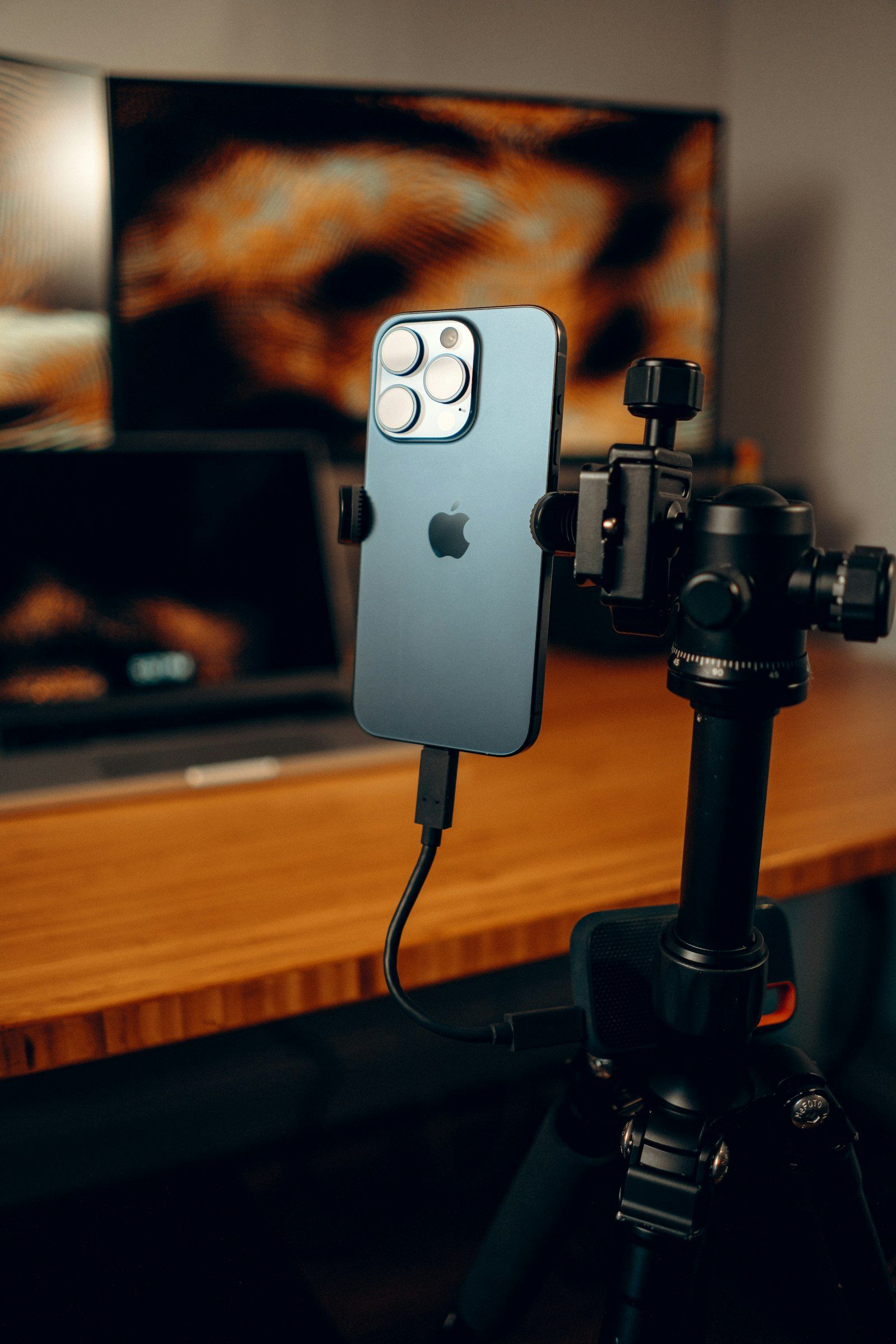
A Basler ace 2 Pro body with a matching 1.1-inch C-mount lens lists around 1,900 euro on Basler's own shop. That is just the sensor head. An iPhone has the camera, ISP, GPU, and neural accelerator on one board. To match that in an industrial stack you add lighting, a mount, cables, and an industrial PC with a GPU that can run a defect model in real time. The complete bundle lands around 4,500 to 5,000 euro at the conservative end, 7,500 to 10,000 euro for a rugged fanless IPC with a proper NVIDIA RTX-class GPU. A refurbished iPhone 15 Pro with a lamp, cables, and an SP Connect mount comes in under 1,000 euro. Same job, same end-to-end setup, five to ten times the cost. This post is the honest read on where the iPhone holds up, where it loses, and how to pick.
Most comparisons online pick a side before reading a datasheet. This one works off the public numbers. We pull the Basler specs from their product documentation, the iPhone specs from Apple's datasheet, and back both sides with published field data rather than tests we did not run. Where it is our own number, like Core ML inference latency or station cost, we say so explicitly.
The spec-sheet comparison
This is a read of published specifications, not a head-to-head lab trial. We do not own a Basler ace 2 Pro, and we do not think anyone should trust a comparison that claims results they cannot reproduce. Where we cite Basler, the link points at Basler's own documentation. Where we cite iPhone performance, the link points at Apple's spec page or our production telemetry. For proof that smartphones can actually carry industrial inspection at scale, the best reference is Ford's Mobile AI Vision System, which has completed over 168 million inspections across roughly 700 stations in 27 plants (details in our smartphone inspection data post).
Optical performance
Resolution and sensor. The Basler ace 2 Pro (a2A5320-23ucPRO) uses a 16.1 MP Sony IMX542 global-shutter CMOS on a 1.1-inch format, per the Basler product documentation. The iPhone 15 Pro main camera captures 48 MP at f/1.78 on a smaller sensor, per Apple's spec sheet. Raw resolution favors the iPhone on paper. Sensor size and per-pixel quality favor the Basler.
Shutter type is the more consequential split. The Basler has a global shutter, meaning every pixel is exposed at the same instant. The iPhone has a rolling shutter, which can smear fast-moving parts when exposure and motion align poorly. For line speeds above two parts per second, the Basler is the safer optical choice. Below that, controlled lighting and the iPhone's on-sensor HDR keep both cameras usable.
Low light. Neither manufacturer publishes dynamic range in decibels on its public datasheet. In our deployments, the iPhone captures clean imagery down to around 200 lux with the default ISP pipeline. Below that threshold, HDR processing can introduce motion artifacts. For factories that control their lighting, which is almost all of them, this rarely matters in practice.
Throughput
Frames per second. The Basler datasheet lists 22.3 FPS at full 16.1 MP resolution. The iPhone records 4K video at up to 60 FPS and supports slo-mo at 1080p 240 FPS, per the same Apple spec page. For raw throughput at 1080p or 4K, the iPhone wins. For full-resolution 16 MP capture, the Basler has the higher sustained frame rate.
Trigger latency. The Basler has opto-coupled GPIO input lines rated for microsecond-range hardware triggers. An iPhone triggers over its app, over USB-C, or over the network, with software-layer jitter in the 10 to 30 millisecond range depending on setup. For robot cells where synchronisation matters, the Basler's wiring wins. For take-a-picture-every-time-a-part-passes workflows, software triggers are fine.
Sync across cameras. Industrial cameras ship with hardware sync lines for multi-camera cells. Consumer hardware needs a software bridge. Our Bridge module handles this for multi-iPhone stations, but software-level sync lands in the 5 millisecond range at best, versus sub-millisecond on Basler with its dedicated trigger architecture.
Shop-floor reality
IP rating. The ace 2 Pro is rated IP30 per its datasheet. IP67 industrial cameras exist, typically as a separate SKU with sealed housing and M12 connectors, at a higher price point. A refurbished iPhone in a food-grade stainless enclosure reaches IP65. For dry factory floors, both are fine. For pressure-wash environments, a dedicated IP67 industrial camera is the right tool.
Operating temperature. The Basler ace 2 Pro is rated for -10 to 50 degrees Celsius per the same datasheet. An iPhone thermally throttles around 35 degrees Celsius ambient in our experience, and can be passively cooled in an aluminum mount for warmer environments. For most indoor European manufacturing floors, both sit comfortably in their operating range. Hot paint booths and foundries push the iPhone out of its comfort zone.
Spare parts and swapping. An industrial camera uses rigid GigE or USB3 cabling rated for a decade of operation. When it fails, you replace it with a spare of the same SKU, usually through the original integrator. An iPhone is designed for hot-swap. If a unit fails mid-shift, a line lead can pull a spare iPhone from the factory's iPhone pool and have it running in minutes, without an integrator visit. This is a durability trade: industrial cameras rarely fail but take time to replace; consumer hardware fails more often but recovers in minutes.
Where iPhone wins
Flexible deployment. An iPhone with an SP Connect-based mount clips in and out of a mounting base in seconds, so moving an inspection from one line to another is a shift-change decision rather than an integrator visit. See our iPhone mounting guide for production lines for how this works mechanically.
AI acceleration. The iPhone 15 Pro's A17 Pro chip carries a 16-core Neural Engine that Apple says runs on-device machine learning up to 2x faster than the prior generation (per Apple's spec sheet). In our Core ML pipeline, defect-detection inference runs below 50 milliseconds per frame on-device. A Basler has no local compute. Inference runs on a paired edge server or PC, which adds latency, a second box, and another point of failure.
Cost per station, apples to apples. An iPhone is a camera, ISP, GPU, and neural accelerator in one device. To match that in an industrial build you pay for each piece. Basler lists the ace 2 Pro body at 1,629 euro and a 1.1-inch C-mount lens such as the C11-1620-12M-P at 259 euro on their shop. Add LED bar or ring lighting around 500 euro, mount and USB 3 cable around 200 euro, and an NVIDIA Jetson AGX Orin class edge AI computer around 2,000 euro to run inference comparable to the Apple Neural Engine. That bundle lands around 4,600 euro before integration labor. For a rugged fanless IPC with an NVIDIA RTX A2000 class GPU and a properly IP-rated lighting enclosure, the bill heads toward 7,500 to 10,000 euro. An iPhone station with a refurbished iPhone 15 Pro, a lamp, cables, and an SP Connect mount lands under 1,000 euro. Across 20 stations that is a six-figure gap that pays for the next capex cycle. For the specific iPhone pick, see our post on which iPhone to pick for industrial QC.
Where industrial cameras win
Sub-millisecond trigger sync across many cameras in a robot cell. Consistent performance at full resolution above 60 FPS. Certified operation at extreme temperature or under washdown. Monochrome or multispectral sensors for materials where colour carries no information. Any application with a true machine-vision integrator already in place and a fixed product line that will not change for five years.
We do not pretend those use cases do not exist. Enao runs on iPhone because the 80 percent of factories that do not need those edges have been paying the full cost of an industrial stack for years.
Picking per defect type
Surface and cosmetic defects above 50 microns: iPhone.
Sub-20-micron geometric measurement: industrial camera with telecentric lens.
Welds at over 1,000 degrees Celsius: industrial camera with filtered optics.
High-mix bottling or packaging lines with 20 SKUs: iPhone.
Class-3 IP67 washdown lines: industrial camera.
For the full guide to where machine vision categories split, see our machine vision systems guide and the vendor comparison.
Enao Vision offers a free pilot so you can evaluate whether your line is in the iPhone 80 percent or the industrial 20 percent. The hardware you need, an iPhone, a lamp, cables and a mount, comes in under €1,000. Our Bridge module handles sync for cells that need two or three iPhones working together. Either way, the decision should be made on your defect type, not on which camera brand your team grew up on.
Get started
Want to see how Enao Vision works on your line? You can get started for free using an iPhone you already have, or try the demo to compare notes with other quality and operations teams putting AI on the shopfloor.
Explore with AI
Discuss this article with your favorite AI assistant
