Machine vision systems in 2026: types and how to pick

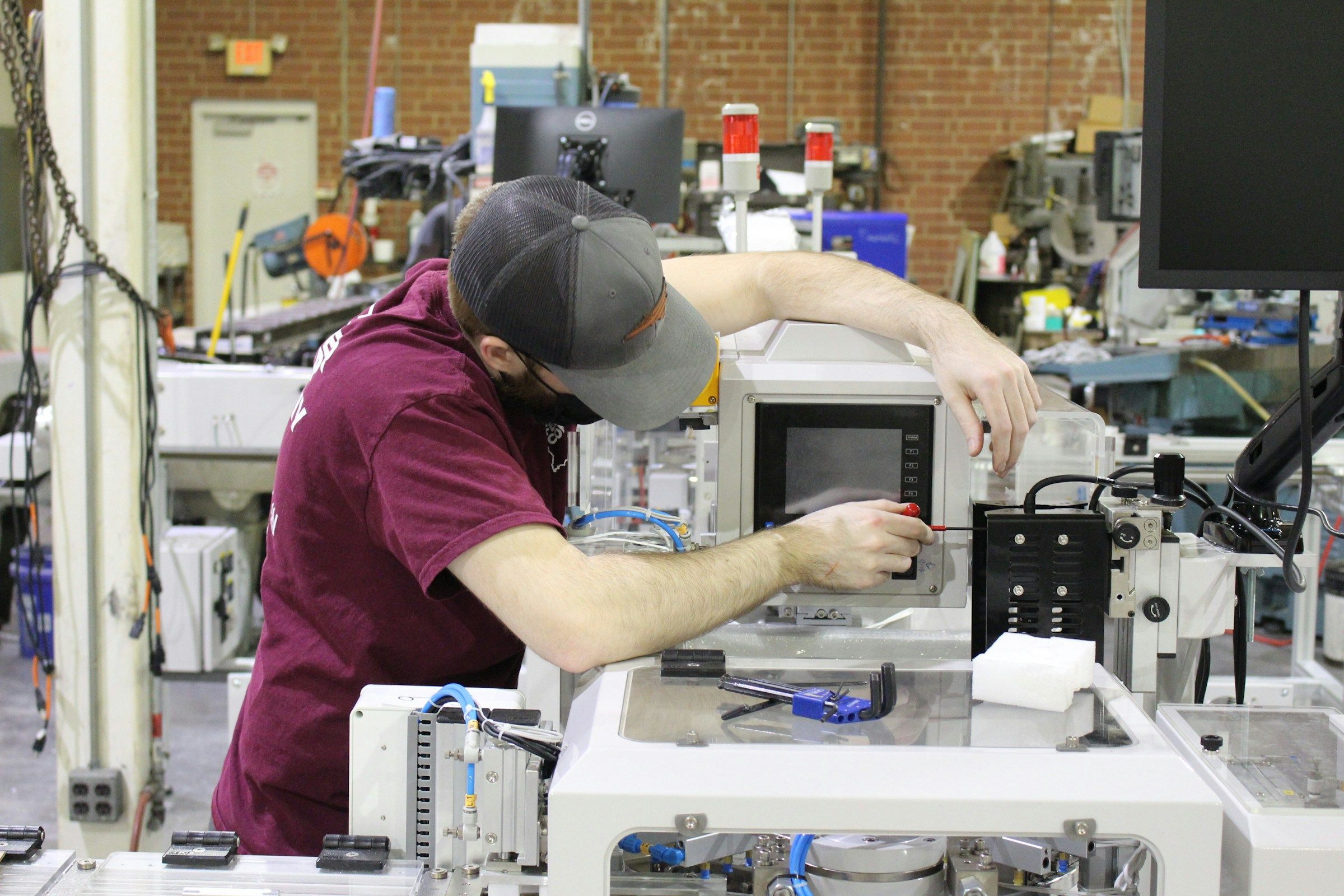
A machine vision system converts light bouncing off a product into an accept-or-reject decision in real-time. The full stack has four layers: a camera captures the image, lighting makes the defect visible, software runs the algorithms that analyse the image and outputs a verdict, and a trigger routes that verdict back into your PLC. Traditional fixed-line systems cost 20,000 to 80,000 euros per inspection station, plus integrator time and changeover downtime. The architecture you choose, not the brand, decides whether that money solves your problem.
Most guides on machine vision systems open with a long history lesson on CCD sensors and Cognex acquisition timelines. We will skip that. If you manage a production line and you have a quality problem that a human inspector cannot keep up with, you need to understand three axes of choice and roughly what each one costs in a real-world production environment. The rest is detail your integrator will sort out.
Where do machine vision systems sit in industrial automation?
A modern factory runs on a tight loop of automation systems: PLCs that drive conveyors, robotic arms that pick and place, MES software that tracks every part, and machine vision systems that act as the eyes of the whole stack. Strip vision out of industrial automation and you are blind to defects until the customer reports them. Add it back, and the same automation that already moves parts around the line can also reject, rework or rebalance them on the fly. Vision is the layer that turns motion into decision.
Robot guidance is the clearest example. A six-axis arm cannot pick a randomly oriented part out of a bin without a vision system telling it where the part is, how it is rotated and whether it is the variant the next station expects. Robotics and machine vision have grown up together for that reason. The same vision feed that handles defect detection on station 7 can drive assembly verification on station 8 and feed real-time corrective signals back to the robotics on station 9. The closer the loop, the less scrap reaches the back of the line.
Two software stacks dominate the algorithms layer. Rule-based libraries codify human expert intuition: edge detection, blob analysis, template matching, calibrated dimensional checks. Artificial intelligence stacks, in particular deep learning convolutional networks, learn the same patterns from labelled images and generalise to variants the rules never saw. Most production-grade machine vision solutions today blend both, with rule-based functions handling the deterministic checks and deep learning handling the messy cosmetic ones.
What counts as a machine vision system?
The full stack works as one loop: the camera captures the image, lighting makes the defect visible, software analyses the image and outputs a verdict, and a trigger plus output route that verdict back into your PLC or reject mechanism. Each layer trades off against the others. Cheap lighting forces more expensive software. A faster camera can simplify the trigger logic. The system only works as well as its weakest layer, which is why most failed machine vision applications turn out to be a lighting problem dressed up as a software problem.
Anything simpler than that, for example a laser distance sensor or a photoelectric beam break, is a presence sensor rather than a vision system. Anything bigger, such as a full inline quality control station with robotics and rejection gates, is still a vision system at its core, just wrapped in more hardware. The same goes for the broader category of vision solutions sold as turnkey appliances: under the hood you will find the same four-layer image processing stack with different packaging, and the quality control logic ultimately routes through the same trigger layer.
For a deeper dive into the individual components, cameras, lenses, lighting and software vendors, see our companion industrial image processing guide, which works through every layer of the stack with reference vendors and price ranges.
One number is worth keeping in your head before you go any further. As a rule of thumb, you want at least 20 to 30 pixels across the smallest defect you need to catch. A 0.3 millimetre scratch on a part that fills a 12 megapixel frame is hard. The same scratch on a part that fills a 2 megapixel frame is impossible. Sensor resolution, lens choice and working distance set that ceiling before any software gets involved.
What does each layer of a machine vision system actually do?
The four layers are not equally expensive or equally important on every line. A surface inspection on glossy metal stands or falls on lighting. A high-speed bottling line stands or falls on camera shutter speed and trigger latency. Knowing which layer is doing the work on your line is what tells you where to spend the money. The same logic applies to every sub-system below the cabinet door, from the cabling that delivers power to the module that hosts inference.
Camera and lens
The camera-and-lens combination defines what the system can physically see. Sensor resolution, pixel size and lens focal length together decide the field of view and the smallest detectable feature. Industrial cameras range from 1 megapixel global-shutter sensors at 400 euros to 50 megapixel scientific sensors above 8,000 euros. Modern smartphone cameras sit at 12 to 48 megapixels with computational stacking, which puts a current iPhone ahead of most industrial cameras under 2,000 euros for the inspection tasks they can be mounted to cover.
Image acquisition is where the rest of the stack begins. A typical fixed-line setup pulls a digital image off the sensor over GigE Vision, USB3 Vision or Camera Link, sometimes via a dedicated frame grabber that buffers and pre-processes pixel data before passing it to the host. Frame grabbers used to be mandatory for line scan and high-speed cameras and are still common in metrology workflows where every microsecond of latency counts. Modern Ethernet-based image capture has eaten most of the lower-end market because GigE Vision frame grabbers can run alongside off-the-shelf network cards. For high-resolution sensors above 25 megapixels at full frame rate, dedicated frame grabbers still earn their place.
Lighting
Lighting is the layer that fails most often, because it is the layer buyers most often skip during specification. Ambient lighting conditions in a factory shift across shifts, seasons and skylight angles. A fixed machine vision system needs its own enclosed light source so the image the camera sees is identical at 03:00 on a Sunday in February and at 13:00 on a Wednesday in July. Lighting choice (ring, bar, backlight, dome, dark field, structured) is dictated by the defect, not by preference. Stable lighting conditions are what give a model its repeatability across shifts.
Software
Software does the actual decision. Rule-based libraries such as Halcon, VisionPro and OpenCV match patterns, measure dimensions and compare intensities against thresholds using classical algorithms (edge detection, blob analysis, geometric matching). Artificial intelligence stacks run convolutional neural networks, most often supervised classifiers and detectors, that learn what "good" looks like from a few hundred reference images. Deep learning lets you skip hand-crafted feature engineering and ship faster on cosmetic defects that classical algorithms cannot describe. The software layer also includes the inference runtime, which can sit on a PC, a smart camera, an embedded edge device or a smartphone, and which dictates the processing speed of the whole loop.
Trigger and output
Trigger and output is the plumbing. A photoelectric sensor or encoder tells the camera when a part is in frame. The decision (pass, fail, fail-with-reason) gets sent back to a PLC over digital I/O, Ethernet/IP or Profinet, which then drives a reject air-blast, a robotic arm, a marking station or simply a counter. Latency budgets are tight: a 300-parts-per-minute line gives the system 200 milliseconds to capture, decide and signal.
How does rule-based machine vision compare to AI-based machine vision?
The oldest split in machine vision is between rule-based systems and AI-based systems. Cognex, Keyence and every classic library (Halcon, OpenCV, VisionPro) started in the rule-based world. The system is programmed to look for specific features. A hole should be 4.2 millimetres in diameter. A logo should sit 12 millimetres from the left edge. A surface should be uniformly grey with a standard deviation below a threshold. The algorithms are deterministic and easy to audit, which is why metrology and assembly verification still lean on them.
Rule-based works beautifully when your product is consistent, your defects are geometrically defined and your lighting is locked down. It breaks the moment reality gets messy. A different batch of raw material, a new product variant, a shift in ambient light from the skylight above the line, and suddenly your false reject rate doubles overnight.
AI-based systems flip the logic. The approach works in two stages. You start by showing the model examples of good parts so it can flag anything that looks unusual, which surfaces candidate defects without anyone labeling them first. Then you label those defects, group them into types and train supervised detection models that classify each one. That second step is what makes the approach robust in production, with high precision and an actionable verdict on every part rather than a plain pass-fail signal. We broke down this trade-off in our practical definition of AI visual inspection and walked through what each approach costs to keep alive once it is in the cabinet.
The practical difference is what happens when your production changes. A rule-based system needs re-programming by an integrator, which typically means a change order and three to six weeks. An AI-based system needs fresh reference images, which a line operator can collect in an hour, and you can optimize the model without touching the cabinet. For a plant that runs more than three product variants a year, that difference compounds fast.
When do you need multiple cameras in a machine vision system?
The second axis is how many angles you need. A single-camera system is the default for flat or cylindrical products inspected from one face. Labels on bottles. Surface defects on sheet metal. Print quality on cartons. One camera, one lens, one lighting setup, one decision.
Multi-camera systems come into play when defects can occur on any face of a three-dimensional part. A machined aluminium housing might need four cameras around it to catch scratches on every side. An injection-moulded part with transparent and opaque regions might need two cameras with different lighting angles firing in sequence.
Multi-camera roughly doubles to quadruples your hardware and software cost. It also multiplies the synchronisation complexity. If camera 1 sees the part at timestamp T and camera 3 sees it at T plus 80 milliseconds, your software has to stitch both frames to the same part ID. Classic systems do this with PLC-triggered encoders. AI systems do it with per-camera inference and a shared reject logic layer.
Rule of thumb: start with single-camera. Go multi-camera only when a defect audit shows that more than 15 percent of your escapes happen on faces your single camera cannot see.
What sensor types do industrial cameras use?
Sensor type is the first hardware decision after you have chosen rule-based versus AI and single-camera versus multi-camera. The type you pick depends on whether the part moves, whether you need depth information and whether the defect is visible in normal light at all. Most industrial cameras still ship with CCD or, more commonly today, CMOS sensors; the choice between them shapes the trade-off between pixel uniformity, readout speed and cost.
Area scan vs line scan cameras
Area scan cameras capture a full 2D frame at each trigger. They cover almost every discrete-part inspection: bottles, cartons, machined components, electronic assemblies. Line scan cameras capture a single row of pixels and rely on the part moving past the sensor to build the image one line at a time. Line scan dominates web inspection (paper, film, fabric, glass) and roller-fed sheet metal because it gives you very high resolution along the direction of travel without buying a huge area sensor. Pair a line scan camera with a frame grabber and a strobed light bar and you can inspect a moving web at several metres per second with sub-millimetre detail.
3D vision systems
When the defect is geometric, like a missing screw, a warped surface or a wrong height, a 2D image is often not enough. 3D vision systems use stereo (two cameras), structured light (a projector plus a camera), laser triangulation (a laser line plus a camera) or time-of-flight sensors to reconstruct depth. They cost two to four times more than 2D systems, which is why most plants reserve them for tasks that absolutely need them: bin picking with robot guidance, weld seam checks, dimensional verification on complex parts.
Hyperspectral and infrared imaging
Some defects are invisible to a normal RGB camera. Moisture under a coating, contamination in a food product, a delamination inside a transparent layer. Near-infrared, short-wave infrared and hyperspectral cameras pick up wavelength bands that human eyes and consumer sensors miss. They are expensive (15,000 to 80,000 euros per camera) and slow, so they show up most often in food, pharma, agriculture and recycling rather than general manufacturing.
What lighting setups work for industrial vision?
Lighting choice is what makes the difference between a system that works on day one and a system that needs a six-month tuning project. The right answer depends on the surface, the defect type and the required contrast under normal lighting conditions on the line.
Ring and bar lighting
Ring lights surround the lens and provide even, mostly diffuse illumination on flat or slightly curved surfaces. Bar lights sit beside the part at a controlled angle. Both are the workhorses of general inspection: presence checks, label reading, OCR, simple surface scratches on metal or plastic. They are cheap (50 to 400 euros), easy to mount and forgiving.
Backlight, dome and dark field
Backlights sit behind the part so the camera sees a silhouette. They are unbeatable for dimensional checks of opaque parts and for transparent products that hide defects against bright backgrounds. Dome lights wrap diffuse light around the part to kill specular reflections on glossy surfaces (anodised aluminium, polished plastic, painted metal). Dark field illumination grazes the surface at a low angle so scratches and dents pop as bright lines against a dark background, which is the opposite of how ring lighting tends to wash them out.
Structured and laser lighting
Structured light projects a known pattern (stripes, dots, a grid) onto the part so the camera can reconstruct surface geometry from the distortion. It is the workhorse of 3D vision in factories. Laser line lighting does the same job for laser triangulation systems, which scan tall or curved parts at very high resolution. Both setups need darker ambient conditions and tend to come bundled with the 3D system rather than chosen separately.
How are machine vision systems deployed?
After sensor and lighting, the next decision is where the inspection actually runs. The deployment model drives capex, footprint and how much of the system can be redeployed when product mix shifts. Each option below ships as a recognisable module that integrators can drop into a cabinet.
PC-based machine vision
PC-based systems pair one or more industrial cameras with a dedicated industrial PC running rule-based or AI software. They give you the most flexibility (multiple cameras, custom logic, complex pipelines) and the most compute headroom for AI models, but they take the most space in the cabinet and the most engineering effort to commission. Typical all-in capex sits between 25,000 and 80,000 euros per station.
Smart cameras
Smart cameras combine the sensor, processor and I/O into one housing. Cognex In-Sight, Keyence CV-X and Basler ace are familiar examples of smart cameras that ship as a single module. They are easier to install, cheaper than a PC-based station and ideal for single-camera inspections with predictable rule-based logic. The trade-off is limited compute, so heavy AI models do not always fit on smart cameras and complex multi-camera setups push you back to PC-based architectures.
Embedded edge and fleet-based devices
The newest deployment model uses small embedded edge devices (Jetson-class boards, smartphones, ruggedised tablets) that run AI inference on-device and connect to a back end for fleet management and model updates. iPhones in this category bring 12-megapixel global-shutter sensors, an A-series neural engine that can run convolutional models in real-time, and a five-year hardware lifecycle on a part the operator already knows how to use. This is what makes fleet-based inspection commercially viable.
What are the most common machine vision applications?
Five machine vision applications cover the bulk of installed capacity in discrete manufacturing. Defect detection on cosmetic and structural flaws is the headline use case: scratches, dents, voids, contamination and missing features. Assembly verification confirms that a multi-step build came out of the cell with every fastener, label and component in the right place, with the right orientation. Barcode and DPM (direct part marking) reading drives traceability across packaging, automotive and electronics. Metrology measures critical dimensions against engineering tolerances, often replacing manual gauging. Robot guidance feeds part poses into a robotic arm so it can pick, place and orient parts that are not perfectly fixtured.
Two more applications round out the list. The first is presence-and-absence checking, the simplest of all functions: is the gasket in place, is the lid closed, is the tamper seal intact. The second is pattern matching for high-quality alignment, which feeds dispensing heads, laser markers and pick-and-place machines that need a reference frame. Each of these use cases lives or dies on validation against ground truth, which is why a pilot with 200 to 500 labelled images is worth more than three months of vendor demos.
Repeatability is what separates a vision system that solves a real-world quality problem from one that drifts after the first product changeover. A useful field test is to run the same 50 known-good and 50 known-bad parts through the system across three consecutive shifts. If the verdict on each part is identical every time, you have repeatability. If two of the 50 parts flip on shift change, your lighting or your model is the problem, not the optics, and you have work to do before tightening tolerances further.
What's the difference between fixed-line and fleet-based machine vision?
The third axis is the newest and the one most guides still ignore. Traditionally every inspection station has been fixed-line. A camera on a rigid mount, a ring light, a sealed enclosure, cabled to a controller in a cabinet. Installation takes two to four weeks. Commissioning takes another two. The station cannot be moved without re-commissioning.
Fleet-based inspection is the mobile alternative that has become practical in the last two years, driven by small form-factor sensors (modern smartphones are now the highest-resolution industrial cameras most factories can afford) and on-device AI. A fleet-based system is a set of portable inspection devices that any operator can pick up, place in front of the line and use to run a random-sample or 100-percent check inside the same production environment, on the same manufacturing process the line was built for.
This matters for three reasons. First, you pay per inspection task, not per camera bolted to a frame, so adding a new inspection point is a per-shift decision rather than a capex project. Second, the same hardware can inspect three different product lines on Monday, Wednesday and Friday if their takt time allows. Third, the inspection can move with the product: into a pre-packing station, onto a trolley at the end of a bottleneck, into a quality lab for deeper sampling. The same fleet covers many use cases without re-buying optics for each.
The mounting setup is what makes this practical in a real plant. With a magnetic clamp, a tripod or a fixed-position holder, the same iPhone can be staged in 90 seconds at one station and re-staged at another after lunch. Our iPhone mounting guide for production lines walks through the three patterns we see most often, what each one costs and where each one fails.
At Enao we focus on exactly this category. As a startup that ships fleet-based machine vision solutions, our wedge is exactly where fixed-line vendors price themselves out. A fleet-based setup using an iPhone and an 80-euro ring light replaces an 80,000-euro fixed station for a useful subset of inspection tasks, especially where volumes or variants make a fixed station unjustifiable.
Which machine vision architecture fits which production line?
The three axes give you eight combinations. In practice five of them cover almost every inspection problem in discrete manufacturing. The list below maps line patterns to the architecture that fits the application requirements you bring in.
- High-volume single-product line, defects geometrically defined, one face: rule-based, single-camera, fixed-line. Think bottling, label printing, gasket dimensional checks. Capex 25,000 to 50,000 euros, payback under two years if escape rate is above 0.3 percent.
- Mid-volume line with frequent variant changes, defects cosmetic and varied: AI-based, single-camera, fleet-based. Think furniture parts, machined components, painted housings. Capex under 5,000 euros to start, scales linearly with the number of stations.
- Three-dimensional part inspected on all faces, stable defect catalogue: AI-based, multi-camera, fixed-line. Think machined aluminium housings, injection-moulded parts with critical surfaces. Capex 50,000 to 120,000 euros, justified when escape cost per part is above 5 euros.
- Continuous web or roll-fed material at high-speed: rule-based, single line scan camera, fixed-line. Think paper, film, glass, sheet metal. Capex 30,000 to 80,000 euros, often replaced or paired with AI for cosmetic checks.
- New inspection task on a line where the defect catalogue is still unknown: AI-based, single-camera, fleet-based. Think a freshly redesigned part, a new supplier, a complaint cluster you cannot yet pin down. Capex under 2,000 euros to start, migrate to fixed-line only once the defect catalogue stabilises.
The last pattern is the one most buyers get wrong. They specify a fixed-line multi-camera rule-based system for a line where nobody yet knows what the defect catalogue looks like. Six months later they own a 90,000-euro system that catches three of the seven defects that actually matter. Starting fleet-based for the first year and migrating to a fixed station once the defect catalogue stabilises usually saves two-thirds of the lifetime cost.
For the finance side of this trade-off, we walked through the capex-versus-opex calculation in a procurement and budgeting note for AI in manufacturing, which is the model we ask new customers to plug their own line numbers into.
Which industries drive machine vision demand?
Three industries account for most of the global machine vision spend. Automotive plants run vision on every welding cell, paint booth and final-assembly station, with strict tolerances on body-in-white panels and engine sub-systems. Semiconductor fabs depend on vision at every step from wafer inspection to die bonding to package marking, with sub-micron repeatability required at line speeds well above what any human inspector can match. Aerospace lives in lower volumes but tighter tolerances, where every fastener torque mark, every weld seam and every composite layup needs traceable validation against the build record.
Outside those three, machine vision is now embedded across food and beverage, pharma, electronics, packaging, logistics, recycling and increasingly furniture and fashion. The common thread is a manufacturing process where defects are expensive enough that catching them before they ship pays for the cameras several times over. Where volumes are smaller or variants more frequent, fleet-based systems often beat fixed stations on TCO. Where volumes are large and the product is stable, fixed-line still wins.
How do machine vision systems integrate with PLCs and MES?
A machine vision system that cannot talk to the rest of the line is a very expensive Polaroid camera. The system integration question is what makes the difference between a station that catches defects and a station that actually changes throughput, scrap and traceability metrics. System integrators charge real money to bridge the gap between a working camera and a working line.
On the PLC side, vision systems publish pass-fail and fault signals over digital I/O for simple cases and over Ethernet/IP, Profinet or Modbus TCP for richer data such as defect class, position and image ID. A reject pulse, a marker fire, a robotic pick or a stop-the-line command typically all live in the PLC and are triggered by the vision verdict in the same scan cycle. Latency budgets between 50 and 200 milliseconds are normal.
On the MES and quality side, the system streams every decision into a database, often with the source image attached. That feed is what powers Pareto charts of defect causes, batch genealogy on bad parts and the SPC dashboards that quality managers actually look at. Cloud-connected fleet-based systems handle this natively because they are network-first by design. Older fixed stations often need a dedicated SCADA or historian connector, which is one of the costs in their three-year TCO. In-house IT teams who already manage the MES backbone will usually save weeks of work by treating the vision feed as just another network endpoint rather than a bespoke serial link.
What's the ROI of a machine vision system?
Three numbers drive the payback calculation: the cost of the defects the system catches, the labour it replaces or augments, and its own lifetime cost. A line shipping 200,000 parts per year with a 0.5 percent escape rate at 12 euros per defect (rework, customer credit, logistics) is losing 12,000 euros a year before any vision system gets involved. Catching 80 percent of those escapes pays back a 25,000-euro fleet-based system in 2.6 years and a 90,000-euro fixed station in 9.4 years.
Labour reduction is the second lever. A full-time inspector at a loaded cost of 50,000 euros a year is the budget against which automated inspection competes. If the system covers 60 percent of that person's tasks, the saving is 30,000 euros a year, which on its own pays back most fleet-based deployments inside 12 months and frees the inspector to optimize the harder cases.
The third lever is upstream. Catching a defect at station 4 instead of at end-of-line saves the conversion cost on every operation between those two points. On a 12-step assembly line, that is often three to five euros per part on top of the original defect cost. ROI models that ignore upstream savings underestimate the value of in-line vision by 30 to 50 percent.
How do you shortlist machine vision systems without regret?
Three questions cut most shortlists in half. They map directly onto the application requirements your line actually has, not the feature list a vendor wants to sell against.
First, how many variants does the system need to handle in its first year of life? If the answer is more than three, rule-based is almost certainly the wrong choice regardless of how low your per-part price is.
Second, what happens if the defect catalogue changes? Ask the vendor for the exact process and timeline to add a new defect class after go-live. A good answer is measured in hours and can be done by a line operator. A bad answer is measured in weeks and requires a site visit. The same question applies to model retraining, system design changes and any retuning the vendor's own engineers need to do behind the scenes.
Third, what is the total cost of ownership across three years, not the list price? A fixed-line rule-based system at 40,000 euros list often costs 120,000 euros across three years once you count integration, re-programming for product changes and the maintenance contract. A fleet-based AI system at 500 euros per device per month is 18,000 euros across three years and covers updates.
If you want to go deeper on the buying criteria, our visual inspection software buyer's guide lists the ten functional questions we see customers wish they had asked before they signed.
How do you get started with machine vision systems?
If you are evaluating machine vision systems right now, the fastest way to learn what fits your line is to run a two-week pilot on one inspection task. Pick the defect that causes the most complaints, gather 200 reference images of good parts and see whether an AI system can flag the bad ones without being told what to look for.
A fleet-based iPhone pilot costs under 1,000 euros in hardware to try. You need a refurbished iPhone, a lamp, cables and a mount. A fixed-line classic system costs 60,000 euros just to get to a quote. The experiment is cheaper than the RFP, and the high-quality images a modern phone produces are good enough to validate whether the inspection problem is even tractable before any procurement cycle starts.
For a curated shortlist of AI-based vendors serving this space, see our comparison of the best AI machine vision systems for 2026, which scores eight vendors on integration depth, time-to-first-inspection and total cost of ownership.
Frequently asked questions
How accurate is a machine vision system on a production line?
Day-one accuracy on a well-defined defect lands at 80 to 90 percent for AI systems and 90 to 99 percent for rule-based systems on simple binary checks. After feedback loops on production data, AI accuracy climbs to 95 to 99 percent, while rule-based accuracy stays where it started but breaks the moment products vary. The number you actually get depends on lighting conditions, the size and quality of the training data, and how big the defect is relative to the sensor's pixels.
How long does it take to install a machine vision system?
Fixed-line traditional systems take four to eight weeks from purchase order to first inspection: two to four weeks for hardware shipping and installation, then two more weeks for commissioning and rule programming. Fleet-based AI systems run in days. You unbox an iPhone, click it into a mount, train a model on 200 reference images, and start inspecting. The trade-off is that fixed-line systems handle higher throughput once they are running, while fleet-based systems are easier to redeploy when product mix shifts.
Can a machine vision system handle multiple product variants?
AI-based systems handle variants well. You collect a few hundred new reference images for each variant and the model adapts in hours. Rule-based systems struggle with variants because each new product typically needs an integrator visit and a fresh round of programming. If your line runs more than three variants a year, factor that difference into your total cost of ownership before you sign the order.
How much does a machine vision system cost in 2026?
Fixed-line systems cost 20,000 to 80,000 euros per inspection station, plus integrator fees of 5,000 to 15,000 euros and an annual maintenance contract. Fleet-based AI systems running on iPhones come in at under 1,000 euros for hardware (refurbished iPhone, lamp, mount, cables) and a software subscription that typically runs 300 to 600 euros per device per month. Across three years, the architecture you choose has more impact on total cost than the brand or feature list.
Smart camera or PC-based: which deployment model is better?
Smart cameras win on simple single-camera inspections where the logic is predictable and the line is space-constrained. PC-based systems win when you need multiple cameras, complex pipelines, heavy AI models or tight integration with custom code. A practical rule: if the inspection runs more than three rules or a deep-learning model that does not fit on the smart camera, the PC-based path is cheaper across three years even though it looks more expensive on day one.
Should you choose a line scan or area scan camera?
Area scan covers almost every discrete-part inspection in factories: bottles, cartons, machined components, electronics. Line scan is the right answer for continuous web inspection (paper, film, glass, sheet metal) and for very high-resolution capture along the direction of travel. If your part stops, gets photographed, then moves, area scan is correct. If your material moves continuously and you need every millimetre at high resolution, line scan is correct.
How long does machine vision system integration usually take?
System integration timelines depend on the architecture. Fixed-line PC-based stations typically need two to four weeks of system design, two more weeks of cabling and PLC integration, and another two to four weeks of validation against golden samples before the line owner signs off. Fleet-based deployments collapse most of that into days because the device, the model and the network endpoint are pre-integrated. In-house engineering teams that already speak Ethernet/IP and OPC UA will save another week on either path.
Key takeaways
- A machine vision system has four layers (camera, lighting, software, trigger) and converts product images into accept-or-reject decisions in real-time, usually under a second.
- Three architectural axes drive most decisions: rule-based versus AI, single-camera versus multi-camera, and fixed-line versus fleet-based.
- Sensor type, lighting setup and deployment model (PC-based, smart cameras or embedded edge) shape capex, footprint and how much of the system can be redeployed when product mix shifts.
- AI-based systems handle product variants and changing defect catalogues without re-programming, which matters most when your line runs more than three variants per year.
- Fleet-based inspection on iPhones replaces 80,000-euro fixed stations for surface, assembly verification and presence checks at a fraction of the lifetime cost.
- Total cost of ownership across three years usually beats list price as the better decision metric: a fixed-line system at 40,000 euros list often costs 120,000 euros over three years.
Get started
Want to see how Enao Vision works on your line? You can get started for free using an iPhone you already have, or try the demo to compare notes with other quality and operations teams putting AI on the shopfloor.
Explore with AI
Discuss this article with your favorite AI assistant
