10 best AI machine vision systems compared in 2026: Cognex, Keyence, Basler and more

Introduction
An AI machine vision system uses industrial cameras, machine learning algorithms and computer vision models to inspect parts on a production line in real time and decide whether each one passes or fails. Automated visual inspection replaces manual inspection with pass-fail decisions made in milliseconds by AI vision systems trained on your specific defects. Modern systems combine deep learning, convolutional neural networks and rule-based image processing on top of high-resolution image sensors to catch defects that human inspectors miss. A convolutional neural network trained on a few hundred labeled images can reach quality inspection accuracy above 95 percent on tasks that would take a rule engine months of tuning. In a smart factory or Industry 4.0 setting, an AI machine vision system is the connection between a physical production process and the data platform that manages quality, traceability and overall equipment effectiveness.
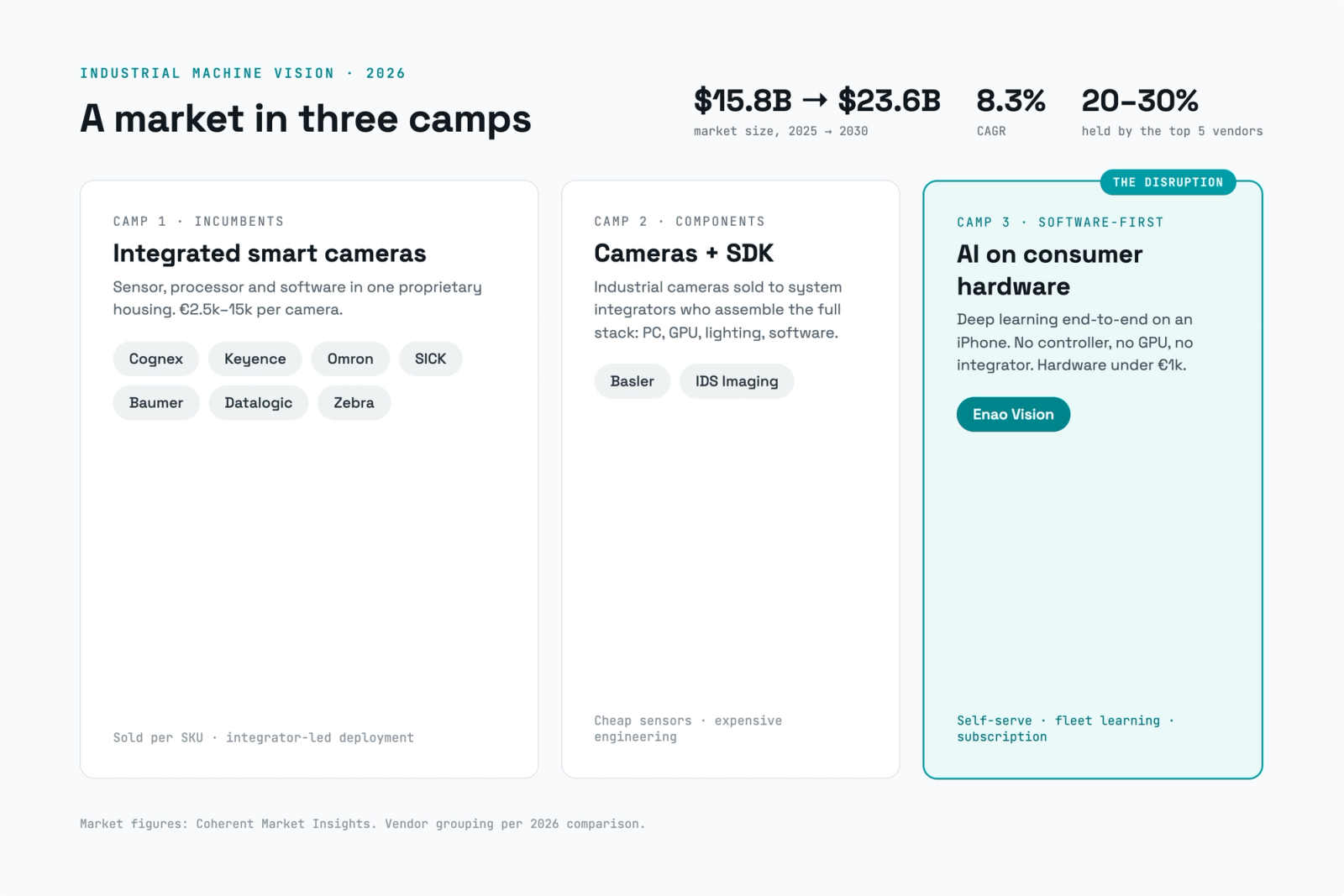
The industrial machine vision market in 2026 splits into three camps. Incumbent vision system manufacturers sell integrated smart-camera platforms and controllers: Cognex, Keyence, Omron, Basler, SICK, Baumer, Datalogic, Zebra Technologies and IDS Imaging. Component camera vendors sell industrial cameras and machine vision software SDKs to system integrators who assemble the full stack. A small group of software-first challengers runs on consumer hardware, with Enao Vision the best-known example. The top five vision system manufacturers together control 20 to 30 percent of the market (Coherent Market Insights), and the overall category is projected to grow from $15.83 billion in 2025 to $23.63 billion by 2030 at an 8.3 percent CAGR.
This post compares 10 machine vision systems side by side, with the specs a process engineer, quality manager or quality assurance lead actually needs to make a purchase decision: sensor resolution, lens options, machine vision software approach, full compute stack, PLC and MES integration, cloud analytics and cross-device fleet learning, three-year total cost of ownership, deployment time, and how the vision system copes with new products. The comparison serves quality control teams across automotive, food and beverage, pharmaceutical, electronics assembly, packaging and general discrete manufacturing.
Executive summary
Ten paragraphs of research and one skimmable answer on which of the ten AI vision systems fits which production line. Here it is.
The industrial machine vision market in 2026 is stable at the top (Cognex and Keyence still dominate on enterprise smart cameras), competitive in the middle (Omron, Basler, SICK, Baumer, Datalogic, Zebra, IDS each own a specific vision technology niche), and disrupted at the low end by software-first challengers running on consumer hardware, of which Enao Vision is the most visible.
Picking the right AI machine vision system is less about who is best in absolute terms and more about which trade-off fits your line:
- Best raw capability, expensive, requires a dedicated vision team: Cognex In-Sight 3800 or D900.
- Fastest legacy option to deploy, exceptional support, still expensive: Keyence VS Series.
- Best fit if you are already on Omron PLCs: Omron FH Series.
- Cheapest camera per megapixel if you have an integrator: Basler ace 2 with Pylon SDK.
- Best rule-based measurement and washdown-grade housing: Baumer VeriSens (IP69K).
- Best code and DPM reading: Datalogic Matrix 320.
- Best subpixel measurement plus high-speed code reading: SICK Inspector and Lector65x.
- Best fit if you already run Zebra scanners elsewhere: Zebra VS40 with Aurora.
- Best 3D depth for bin picking or robot guidance: IDS Imaging Ensenso.
- Flexibility and speed of deployment, AI-native performance, lowest upfront capex: Enao Vision. One iPhone covers four lenses and mounted, manual-station or handheld modes with IP68 out of the box; deep learning end-to-end on the iPhone Neural Engine; hardware under €1,000 with no dedicated vision engineer required.
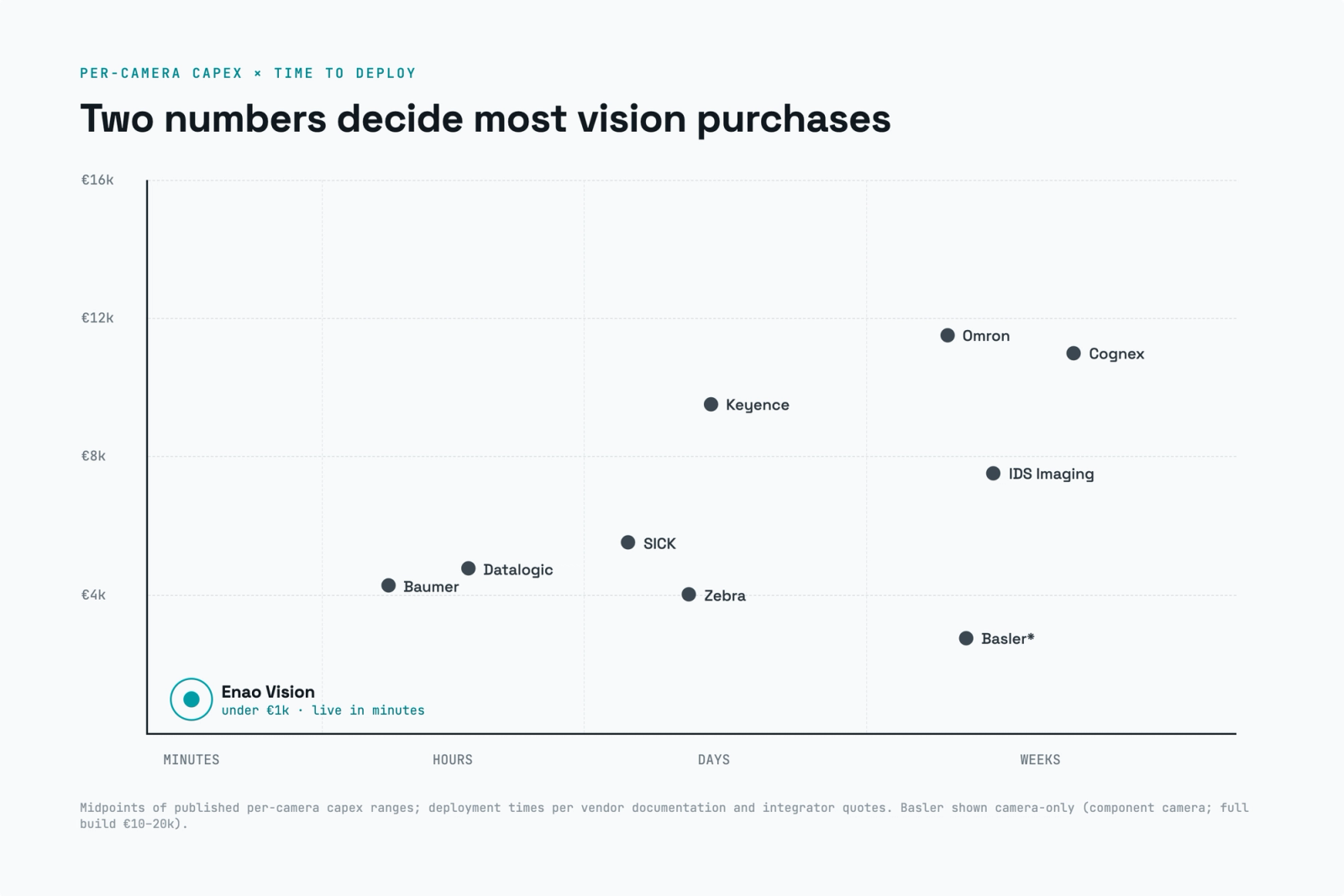
Three numbers that decide most machine vision purchases: per-camera capex ranges from around €1,000 total setup with Enao Vision to €15,000 for a top-of-line Cognex or Keyence smart camera. Deployment time spans minutes (Enao Vision) to weeks (Cognex, Omron), with Keyence and Baumer sitting in the days-range middle. Adaptability to new products is where deep-learning-first systems (Cognex, Keyence, Enao) beat rule-based systems (SICK, Baumer, Datalogic) once product variety climbs above two or three SKUs per line.
Everything below is the detail behind those calls.
The 10 AI machine vision systems at a glance
Two grouped tables so the summary stays scannable. First for hardware and compute stack, second for machine vision software, integration and cost.
Table 1: hardware and compute stack
| Vendor | Flagship system | Max resolution | IP rating | Integrated code reading | 3D option | Full stack (compute needed beyond the camera) |
|---|---|---|---|---|---|---|
| Cognex | In-Sight D900 / 3800 / L38 | 12 MP (2D) | IP67 | Yes (native) | Yes (L38) | Standalone smart camera. VisionPro deep-learning add-on requires PC. |
| Keyence | VS Series / IV4 / CV-X | 25 MP | IP67 | Yes | Yes (LJ-X8000) | Standalone (VS + IV4). CV-X needs XG controller (industrial PC unit). |
| Omron | FH Series | 20.4 MP | IP67 | Yes | Yes | Requires FH controller unit (industrial PC). Up to 8 cameras per controller. |
| Basler | ace 2 Pro (+ Pylon SDK) | 24 MP (Sony Pregius S) | IP-boxed via integrator | Via SDK | Yes (blaze 3D) | Component camera. Requires host PC. GPU recommended for deep learning. |
| SICK | Inspector PIM60 / Lector65x / InspectorP64x | 4 MP (Inspector) | IP67 | Yes (Lector series) | Yes (TriSpector 1030) | Standalone smart camera. |
| Baumer | VeriSens XC / XF series | 1.9 MP | IP69K | Yes (native codes) | No | Standalone smart camera. |
| Datalogic | Matrix 320 / P2x smart camera | 5 MP | IP67 | Best-in-class | No | Standalone smart camera. |
| Zebra Technologies | VS40 (Aurora software) | 2.3 MP | IP67 | Native | No | Standalone smart camera. |
| IDS Imaging | Ensenso N/C/X 3D | Depth-optimized | IP65/IP67 | Via SDK | 3D native | Component 3D camera pair. Requires host PC. GPU recommended for real-time depth. |
| Enao Vision | iPhone 15 Pro / 17 Pro | 48 MP (Fusion) | IP68 (iPhone-native) | Native (all 1D + 2D codes) | Depth via LiDAR (Pro only) | Standalone. iPhone Neural Engine runs models on-device. No external PC or GPU. |
Table 2: machine vision software, integration, cloud analytics and cost
| Vendor | Software approach | PLC integration | Cloud analytics / fleet learning | Approx. per-camera capex | Full-line capex including compute + PLC integration |
|---|---|---|---|---|---|
| Cognex | Deep learning (ViDi) + edge learning | OPC UA, EtherNet/IP, PROFINET via gateway | Cognex Edge Intelligence, Cognex Insights (cloud dashboards) | €7,000 to €15,000 | €15,000 to €30,000 |
| Keyence | Deep learning, auto-configured | EtherNet/IP, PROFINET, native EtherCAT | Local-first vendor; limited cloud story | €7,000 to €12,000 | €12,000 to €22,000 (VS standalone); €18,000+ (CV-X with controller) |
| Omron | Rule-based + AI defect detection | Native EtherCAT via Sysmac, EtherNet/IP | Sysmac Studio local + cloud via third-party gateways | €8,000 to €15,000 per camera | €18,000 to €35,000 (includes FH controller) |
| Basler | Component camera + Pylon SDK | Via host PC and integrator | None native; runs in integrator's chosen stack | €1,500 to €4,000 (camera only) | €10,000 to €20,000 (with PC, GPU, integrator time) |
| SICK | Rule-based + web server config; SICK AppSpace | OPC UA, EtherNet/IP, PROFINET | SICK Do More Analytics (cloud platform); SICK Edge Gateway | €3,000 to €8,000 | €6,000 to €14,000 |
| Baumer | Rule-based subpixel (FEX processor) | EtherNet/IP, PROFINET, digital I/O | Web-based local dashboards; no cloud fleet management | €2,500 to €6,000 | €4,000 to €10,000 |
| Datalogic | Code reading dominant + smart imaging | Native OPC UA, EtherNet/IP, PROFINET | Datalogic Studio (local); limited cloud analytics | €2,500 to €7,000 | €5,000 to €12,000 |
| Zebra Technologies | Aurora AI + AI-OCR | EtherNet/IP, PROFINET, PoE for power + data | Zebra IoT platform for cross-device fleet management | €2,500 to €5,500 | €6,000 to €12,000 |
| IDS Imaging | 3D structured light + stereo, via SDK | Via host PC and integrator | None native; runs in integrator's stack | €3,000 to €12,000 | €12,000 to €25,000 (with PC, GPU, integrator time) |
| Enao Vision | Deep learning end-to-end + macro mode | HTTP webhook, OPC UA gateway, MES/ERP webhook, 24 V signal over USB-C | Native cloud dashboards, cross-device fleet learning, weekly OEE summaries, model improvement pooled across deployed devices | Under €1,000 total setup (refurbished iPhone, cables, mount) | Under €1,000 (no additional PC, GPU or controller) |
Per-camera capex figures cover the smart camera or camera-plus-controller only. The rightmost column adds host PC and GPU where required, plus typical integrator time for PLC connectivity, but excludes lighting and mounting hardware since those apply to every vendor equally. Sources: vendor specification sheets (Cognex In-Sight 2800, Basler ace 2, Baumer VeriSens, Datalogic Matrix 320, SICK Inspector PIM60, Zebra VS40, IDS Ensenso), integrator quotes cited in industry press, and the Averroes and Detect Defects vendor comparison studies (Averroes.ai, Detect Defects).
Not sure which AI machine vision system fits your line? Try the Enao Vision demo in a browser in 60 seconds to see one modern approach in action, no signup required.
The 10 AI machine vision systems in detail
1. Cognex In-Sight (D900, 2800, 3800, L38)
Cognex is the most recognized brand in industrial machine vision and the reference point most integrators start from. The In-Sight smart camera family now spans four tiers.
Specs at a glance:
- In-Sight 2800: pre-trained AI, edge learning classifier, 45 FPS (Cognex spec sheet)
- In-Sight 3800: AI-powered smart camera, 125 FPS, twice the processing power of the D900, color and monochrome and multispectral options (Cognex spec sheet)
- In-Sight D900: 12 MP, IP67, ViDi deep learning software, up to 50 FPS
- In-Sight L38: 3D vision system with a laser sensor and VisionPro machine vision software
- Runs on the In-Sight OS or VisionPro, both proprietary
- Digital I/O, OPC UA bridge, Ethernet/IP, PROFINET via gateway
What Cognex In-Sight does well: handles the most demanding defects reliably, from worn text on PCBs (a bread-and-butter PCB inspection task) to scratches on shiny surfaces and complex assemblies. The EasyBuilder interface walks first-time users through smart camera setup. The multispectral options on the newer 2800 and 3800 open applications in food and pharma where color and IR responses matter.
Where Cognex In-Sight lags: expensive by any measure. Between €7,000 and €15,000 per smart camera before you add software licenses, lighting, integration and training. Locked to Cognex hardware and software. Cognex often recommends paid training and integrator programs to reach the full feature set.
Best fit: large manufacturers with a dedicated machine vision team, complex quality inspection problems, and capex budget in place.
2. Keyence VS Series (and IV4, CV-X)
Keyence competes with Cognex on smart-camera machine vision. Three product lines matter for most factories:
Specs at a glance:
- VS Series: up to 25 MP, integrated optical zoom (ZoomTrax) with 19 lenses in one IP67 smart-camera housing, minimal training images
- IV4 Series: the successor to the widely deployed IV3 line, sold as separate models per field of view (IV4-600MA mono wide, IV4-600CA color wide, narrower FOV variants on other model numbers)
- CV-X Series: system-level controller with multi-camera support and rule-based algorithms
- All Keyence smart cameras: IP67, native barcode and 2D matrix code reading, digital I/O plus EtherNet/IP or PROFINET
- Machine vision software auto-tunes lighting, focus and detection on first run
What Keyence does well: fastest legacy option to deploy. Auto-configuration means a non-specialist can bring a line online in days rather than weeks. Keyence documentation and support are widely regarded as the best in the industry.
Where Keyence lags: proprietary and expensive. Each field of view is a separate SKU (three focal-length coverage means three cameras). Feature-dense dashboards can be overwhelming. Sub-micron semiconductor-level work is out of reach for the VS Series.
Best fit: mid-to-large manufacturers running frequent product changes who need speed of deployment over deep customization.
3. Omron FH Series (and MicroHAWK)
Omron's flagship FH Series takes a hybrid rule-based-plus-AI approach and integrates natively with the rest of Omron's industrial automation stack.
Specs at a glance:
- Up to 20.4 MP
- Up to 8 cameras per FH controller (industrial PC-based unit)
- Self-learning AI defect detection layered on rule-based algorithms
- Native EtherCAT, Sysmac Studio, EtherNet/IP integration
- MicroHAWK line for lower-throughput 2D code reading
What Omron does well: seamless fit with Omron PLCs, Sysmac Studio, and Omron's robotic cells. The AI self-learning tool automatically picks representative training images. Multi-camera on one controller reduces wiring and cabinet space in robotic cells with several inspection angles.
Where Omron lags: integration effort is high if you are not already in the Omron ecosystem. The AI layer sits on top of a rule-based core, which limits how much a deep-learning model can adapt across product changes. Deployment typically requires weeks of integrator work.
Best fit: manufacturers already committed to Omron industrial automation who want to add vision inspection without switching PLC or MES stacks.
4. Basler ace 2 (with Pylon SDK)
Basler is different from the four vendors above. It sells industrial cameras, not integrated machine vision systems. A Basler ace 2 becomes a machine vision system only after an integrator adds lighting, a lens, a processor and machine vision software.
Specs at a glance:
- ace 2 Basic and ace 2 Pro lines, both with GigE Vision or USB 3.0 interfaces (Basler product page)
- Fourth-generation Sony Pregius S CMOS sensors, up to 24 MP
- Global shutter, C-mount lens interface
- Royalty-free Pylon SDK for camera control and integration
- Add-on blaze 3D camera for depth applications
What Basler does well: excellent price-to-performance on raw sensor capability. Full software control via the Pylon SDK. The C-mount interface means you pick the lens that fits the working distance and field of view rather than accepting a fixed integrated optic. Basler is the go-to industrial camera for vision system integrators building custom systems.
Where Basler lags: not a turnkey machine vision system. You need an integrator or in-house engineering team to combine the camera with lighting, machine vision software, processing hardware and PLC connectivity. No native smart-camera dashboard for non-engineers.
Best fit: system integrators, OEMs and manufacturers with in-house engineering capacity who need per-line customization.
5. SICK Inspector PIM60 (and Lector65x, InspectorP64x)
SICK's machine vision portfolio spans three families that a process engineer typically evaluates:
Specs at a glance:
- Inspector PIM60: vision sensor with smart-camera performance, subpixel measurement, calibration for angled mounting, integrated web server for cost-effective monitoring
- Lector65x: image-based code reader with dynamic focus and a large field of view for high-speed lines
- InspectorP64x: mid-tier vision system with programmable applications
- IP67 rating across the range
- Digital I/O, EtherNet/IP, PROFINET, OPC UA
- SICK's own SICK AppSpace platform for building custom inspection apps
What SICK does well: measurement accuracy at subpixel level. The results-calibration function outputs measurements in millimeters directly for robot or gripper control, which shortens the loop for automation cells. SICK's Lector65x has one of the best dynamic-focus code-reading engines in the industry, popular in intralogistics and packaging.
Where SICK lags: less well-known in deep-learning defect detection than Cognex or Keyence. The programming environment is powerful but has a learning curve. Best specs land on measurement and code reading, not on AI classification.
Best fit: manufacturers doing dimensional measurement, presence-absence, and code reading at high speed, especially in intralogistics, packaging and process control loops.
6. Baumer VeriSens
Baumer's VeriSens series is a family of configurable smart vision sensors aimed at inline inspection tasks that need better than a photoelectric sensor but less than a full deep-learning system.
Specs at a glance:
- Resolutions from 752 × 480 up to 1600 × 1200 pixels (about 1.9 MP)
- Baumer's patented FEX image processor for subpixel contour analysis in real time
- 23 different feature checks for defect detection
- Up to 100 inspections per second in high-speed mode
- Integrated illumination, lens, machine vision software, Ethernet and digital interfaces
- IP69K options for washdown environments
- Universal Robots-compatible variants for cobot cells
What Baumer does well: purpose-built for fixed-inspection tasks with predictable geometry: label position, orientation, presence, dimensional measurement. The FEX processor genuinely runs at line speed for subpixel-level work. IP69K makes it a fit for food and pharma washdown.
Where Baumer lags: rule-based configuration, not deep learning inspection. Resolution tops out at 1.9 MP, so tiny defects on large parts are out of reach. Deep-learning first workflows are not the design point.
Best fit: OEM machine builders and food/pharma manufacturers who need rugged rule-based inline inspection with a low integration effort.
7. Datalogic Matrix 320 (and P2x smart cameras)
Datalogic is the code-reading specialist in this list. The Matrix 320 and P2x families are best-in-class for label reading, DPM (direct part marking), and 1D and 2D code capture at production speed.
Specs at a glance:
- 2 MP or 5 MP sensor options (Matrix 320 5MP announced as newer flagship)
- Up to 60 images per second
- Modular design with a complete portfolio of lenses, lightings and filters
- Smart configurable lighting in three colors (multi-color illumination for hard-to-read codes)
- HDR capability, high depth of field independent from focus selection
- OPC UA, EtherNet/IP, PROFINET
- IP67 aluminum housing
What Datalogic does well: excels at barcode reading and reads codes other scanners miss (worn DPM, low-contrast marks, curved surfaces, high line speeds). The tri-color lighting solves the toughest traceability problems. Native OPC UA makes MES integration straightforward.
Where Datalogic lags: not designed for general defect detection or classification. Not a deep learning inspection platform. If your primary need is defect inspection rather than code reading, Cognex, Keyence or Enao Vision is the right shortlist.
Best fit: manufacturers with heavy traceability or track-and-trace requirements (automotive, pharma, food, electronics assembly, e-commerce logistics).
8. Zebra Technologies VS40 (Aurora software)
Zebra Technologies brought its retail-and-logistics scanning heritage into industrial machine vision through the Aurora software platform and the VS40 smart camera.
Specs at a glance:
- 2.3 MP monochrome sensor, color and near-IR variants
- 45 FPS
- Integrated liquid lens for auto-focus at variable working distances
- Built-in lighting, AI-powered optical character recognition (AI-OCR), ImagePerfect+ (16 image variants per capture)
- IP67, aluminum housing, chemical and oil resistant
- Ethernet, USB-C, serial, Power over Ethernet (PoE)
- Zebra Aurora software platform
What Zebra does well: Quick Draw setup (draw on the image to create an inspection tool). Aurora is genuinely one of the easier smart-camera platforms for non-engineers. Liquid lens auto-focus is a real ease-of-use benefit. AI-OCR pulls in Zebra's decade of code and character reading. Zebra's IoT stack also opens the door to adjacent capabilities like predictive maintenance on the vision hardware itself.
Where Zebra lags: 2.3 MP is on the low end of the field for defect inspection. The AI feature set is narrower than Cognex ViDi or Keyence VS. Zebra's industrial machine vision play is newer than its retail lineage, and the ecosystem of integrators is smaller.
Best fit: manufacturers who already run Zebra scanners in warehouse or track-and-trace applications and want a coherent vendor stack across logistics and production.
9. IDS Imaging Ensenso (N, C, X series)
IDS Imaging occupies the 3D machine vision specialist slot in this list. The Ensenso family targets bin-picking, robot guidance, and volumetric measurement rather than 2D defect inspection.
Specs at a glance:
- Ensenso N series: compact stereo 3D, IP65/IP67, factory-pre-calibrated
- Ensenso C series: color 3D imaging with dual CMOS + RGB overlay
- Ensenso X series: modular 3D system with 100 W LED projector and Gigabit Ethernet switch
- Two global-shutter CMOS sensors with pattern projector for structured-light stereo
- Robust aluminum housing, GPIO with 12-24 V hardware trigger
- SDK-driven integration, Halcon and OpenCV compatible
- Techman Robot Plug and Play certification
What IDS Ensenso does well: 3D depth measurement in industrial-grade housings. Pre-calibrated stereo pairs remove one of the hardest setup steps in 3D vision. Well-suited to robotic guidance in cobot cells.
Where IDS Ensenso lags: 3D-only positioning means Ensenso is not the answer for 2D defect inspection tasks. Requires an integrator with 3D vision experience. Not a plug-and-play smart camera for the shop floor.
Best fit: robotic bin-picking, palletizing, volumetric measurement, and any inspection that needs depth data (not just 2D color or contrast).
10. Enao Vision
Enao Vision takes a different approach from all ten vendors above. Instead of a proprietary smart camera, it turns an iPhone into a real-time inspection and production monitoring platform for AI quality control.
Specs at a glance:
- Runs on iPhone 15 Pro, iPhone 17 Pro, or equivalent Pro-line devices
- Up to 48 MP main sensor (Fusion), Ultra Wide with macro mode down to 10 cm working distance, 2× lossless crop, 3× telephoto
- Four fields of view from a single device (0.5×, 1×, 2×, 3×), reconfigurable in machine vision software between shifts
- Sub-millimeter defect detection in macro mode (0.26 mm at 10 cm, 11.57 pixels per millimeter; see the iPhone field of view breakdown for the numbers per lens per working distance)
- IP68 out of the box (iPhone-native, submersion up to 6 m for 30 minutes per Apple specification)
- Deep learning end-to-end, iPhone Neural Engine for on-device inference (no external PC or GPU)
- Handheld mode, mounted mode, and manual-workstation mode from the same app
- USB-C for Ethernet, 24 V signal output, and PLC integration
- HTTP webhook, MES/ERP webhook, OPC UA gateway integration
- Cloud dashboards, cross-device fleet learning, weekly OEE summaries and pooled model improvement across deployed devices
- Hardware under €1,000 total setup: refurbished iPhone, cables, mount
What Enao Vision does well: fastest time-to-first-inspection in this comparison. A process engineer downloads the app, mounts the phone, and starts inspecting within an hour. Four lens options from one device means one iPhone covers the same field of view range that a Keyence or Cognex installation would need three separate SKUs to hit. Macro mode captures sub-millimeter defects (down to what many QM teams call micro-defects, in the 0.26 mm to 1 mm range) that most integrated smart cameras cannot resolve without dedicated macro optics. Handheld operation supports inspection of large or awkward parts a fixed camera cannot reach. Integration is HTTP-first, so it plugs into MES, ERP, PLCs and dashboards without a new vendor stack.
Where Enao Vision lags: IP68 covers dust and water submersion, but the IP69K high-pressure high-temperature washdown rating that Baumer VeriSens carries is not on the iPhone specification sheet, so heavy chemical or steam washdown environments still call for a purpose-built enclosure. Wi-Fi dependency has caused deployment friction on plants with weak wireless coverage. Sub-micron semiconductor manufacturing or medical-device inspection is not the design point. Deep learning accuracy starts at roughly 80 percent on day one and improves with worker feedback, which is a fit for gradual rollouts but not for zero-defect launch requirements from the first shift.
Best fit: any manufacturer that values flexibility, AI-native performance and low upfront capex over locked-in enterprise vendor stacks. Especially strong for mid-market plants running many SKU changes, teams without a dedicated vision engineer, and rollouts that need to prove out in weeks not months.
Curious how this looks on your line? Try the demo in a browser in 60 seconds. No signup, no email, no install.
Comparing AI machine vision systems: six dimensions that matter
Hardware capability
Image sensor resolution from 2 MP to 25 MP determines how small a defect you can spot at a given working distance. The image sensor type also matters: global-shutter CMOS sensors like Sony Pregius S (used in the Basler ace 2) freeze motion cleanly at high line speeds, while rolling-shutter sensors are cheaper but can distort fast-moving parts. Frame rate of 30 to 125 FPS keeps inspection in step with high-speed lines. IP67, IP68, or IP69K handles dust, water, oil mist and washdown to varying degrees.
Cognex and Keyence lead on raw industrial camera specs among enterprise smart cameras. Basler ace 2 offers the highest sensor performance for the price if you can bring an integrator. Baumer VeriSens tops IP protection with IP69K (high-pressure high-temperature washdown). Enao Vision on iPhone 17 Pro delivers 48 MP on the main sensor, IP68 out of the box per Apple's specification, and resolves sub-millimeter defects at typical working distances of 0.5 to 2 meters. The iPhone wins on flexibility (four lenses in one device, reconfigurable in software) at the cost of the specialized IP69K rating that a pharma washdown line would insist on.
Machine vision software: rule-based, machine learning, or deep learning
Machine vision software splits into three approaches that a process engineer should understand before choosing a system.
Rule-based machine vision software uses hand-configured geometric measurement, template matching, edge detection and color thresholding. Every rule is explicit. The engineer defines what "good" looks like, and the vision system flags anything outside the tolerance. Rule-based tools handle presence-absence, dimensional measurement, orientation and label position at production speed with very low compute requirements.
Machine learning-based systems classify parts from a small labeled dataset of good and bad examples. The classifier learns patterns the engineer would struggle to codify explicitly. Cognex In-Sight 2800 uses edge learning, a lightweight machine learning approach that trains a classifier on 5 to 20 example images directly on the smart camera without cloud training.
Deep learning inspection goes further. It uses convolutional neural networks trained on thousands of labeled images to read shiny surfaces, varying textures and worn text where rules and shallow classifiers both fail. Deep learning models capture the abstract visual features a human inspector uses without any explicit rule set. Common deep-learning tasks include object detection (locating and classifying parts in a frame) and anomaly detection (flagging anything that does not match a learned distribution of good parts). Both increasingly run at the edge, thanks to edge computing hardware in modern smart cameras that removes cloud latency and network dependency.
Cognex ViDi and Keyence Auto-Image are deep-learning-first. Omron FH Series adds artificial intelligence on top of legacy rule-based algorithms. Baumer VeriSens and SICK Inspector PIM60 are rule-based. Datalogic Matrix 320 is code-reading dominant. Enao Vision runs deep learning end-to-end on the iPhone Neural Engine, with continuous learning from worker feedback on the app. The right approach depends on the inspection: rule-based is faster to configure for well-defined geometric checks, deep learning wins where the defect is hard to describe in code, and a hybrid combines the two.
Integration with PLCs, MES and line controllers
Modern factory floors run on PLCs speaking EtherCAT, PROFINET or OPC UA, with MES dashboards on top for traceability and OEE. Omron integrates natively with Sysmac Studio. Cognex and Keyence expose digital I/O and OPC UA bridges plus their own gateway boxes. SICK adds native SICK AppSpace with OPC-UA (also written OPC UA) as first-class. Datalogic's OPC UA is built in. Enao Vision pushes inspection results, pass/fail counts and defect images to MES, ERP or any system that accepts an HTTP webhook, which is the lightest integration footprint of the ten.
Total cost of ownership over three years
Capex on a single Cognex, Keyence or Omron smart camera runs €7,000 to €15,000. Machine vision software licenses, lighting and integration add €8,000 to €25,000 per line. Basler and Baumer come in cheaper on capex but add integrator cost. SICK, Datalogic and Zebra sit in the €2,500 to €8,000 hardware range per camera before integration. IDS Ensenso is €3,000 to €12,000 for a 3D camera pair. Stacking three lines triples the number, with refresh cycles every five to seven years.
Enao Vision's subscription model flips the math: hardware stays under €1,000 per line (refurbished iPhone, cables, mount) and software cost grows linearly with usage rather than stepping up per new camera or per new inspection task. Over three years the gap widens further once rework reduction and faster root cause analysis are factored in.
Deployment time
Cognex and Omron typically need an integrator on site for weeks. Keyence trims that to days thanks to integrated optics and auto-configured detection. Basler needs an integrator to build the full system. Baumer VeriSens configures in hours if the inspection is straightforward. SICK Inspector configures in a day through its web server. Datalogic Matrix 320 deploys quickly for code-reading applications. Zebra Aurora is fast for its target applications. IDS Ensenso needs 3D-experienced integrators. Enao Vision deploys in minutes per line: a process engineer downloads the app, sets the camera angle and lighting, and starts collecting first inspections.
Adaptability to new products
Modern lines launch new products every quarter, sometimes every month. Cognex, Keyence and Omron typically need a fresh batch of labeled visual data and a model rebuild for each new defect type. Basler, Baumer and SICK require a new rules configuration or dataset. Enao Vision keeps the same model and adds a handful of examples on the iPhone, which is how the system stays useful through quality assurance processes that evolve quarter over quarter.
How to choose an AI machine vision system
Before comparing vendors, run through five questions that determine which class of machine vision system fits your production process.
1. What are you actually inspecting? A geometric measurement (dimension, angle, position) rewards a rule-based vision sensor with subpixel precision, like SICK Inspector PIM60 or Baumer VeriSens. A hard-to-describe defect (a scratch on a shiny surface, a print quality issue on curved packaging) rewards deep learning inspection on Cognex ViDi, Keyence Auto-Image or Enao Vision. A barcode, DPM code or serial number rewards a dedicated code reader like Datalogic Matrix 320 or SICK Lector65x.
2. What is the working distance and how small is the smallest defect you need to detect? Working distance and defect size together set the required resolution and lens choice. A defect under 1 mm at a working distance over 1 m needs high resolution plus tight optics. See how small a defect and how big a product one iPhone can actually inspect for the field-of-view math per lens per working distance.
3. How many SKUs and how often do they change? If your production line runs one high-volume SKU that never changes, a rule-based smart camera pays back its integration cost. If your quality control process handles many SKUs that change quarterly, deep learning systems that fine-tune on new examples (Enao Vision, Cognex, Keyence) hold their accuracy through product changes without a fresh integrator visit.
4. What is your integration surface? If the vision system needs to push results into an existing MES, ERP or PLC, prioritize vendors with the protocols your plant already speaks. Omron FH integrates natively via Sysmac Studio for Omron PLCs. Cognex, Keyence, SICK and Datalogic all speak OPC UA and PROFINET. Enao Vision uses HTTP webhooks that plug into any MES, ERP or dashboard that accepts REST calls.
5. Who will configure and maintain the system, and how much manual inspection are you replacing? A dedicated vision engineer can absorb Cognex VisionPro or Basler Pylon SDK. If the goal is replacing manual inspection at a specific station, prioritize systems your process engineer can configure without help. A process engineer or quality manager without vision background will get further faster with Keyence auto-configuration, Zebra Aurora Quick Draw or Enao Vision's iPhone app. This is the question that separates a machine vision project that gets used from one that gets shelved after the integrator leaves.
Which AI machine vision system fits your production line?
A quick decision guide for the most common situations:
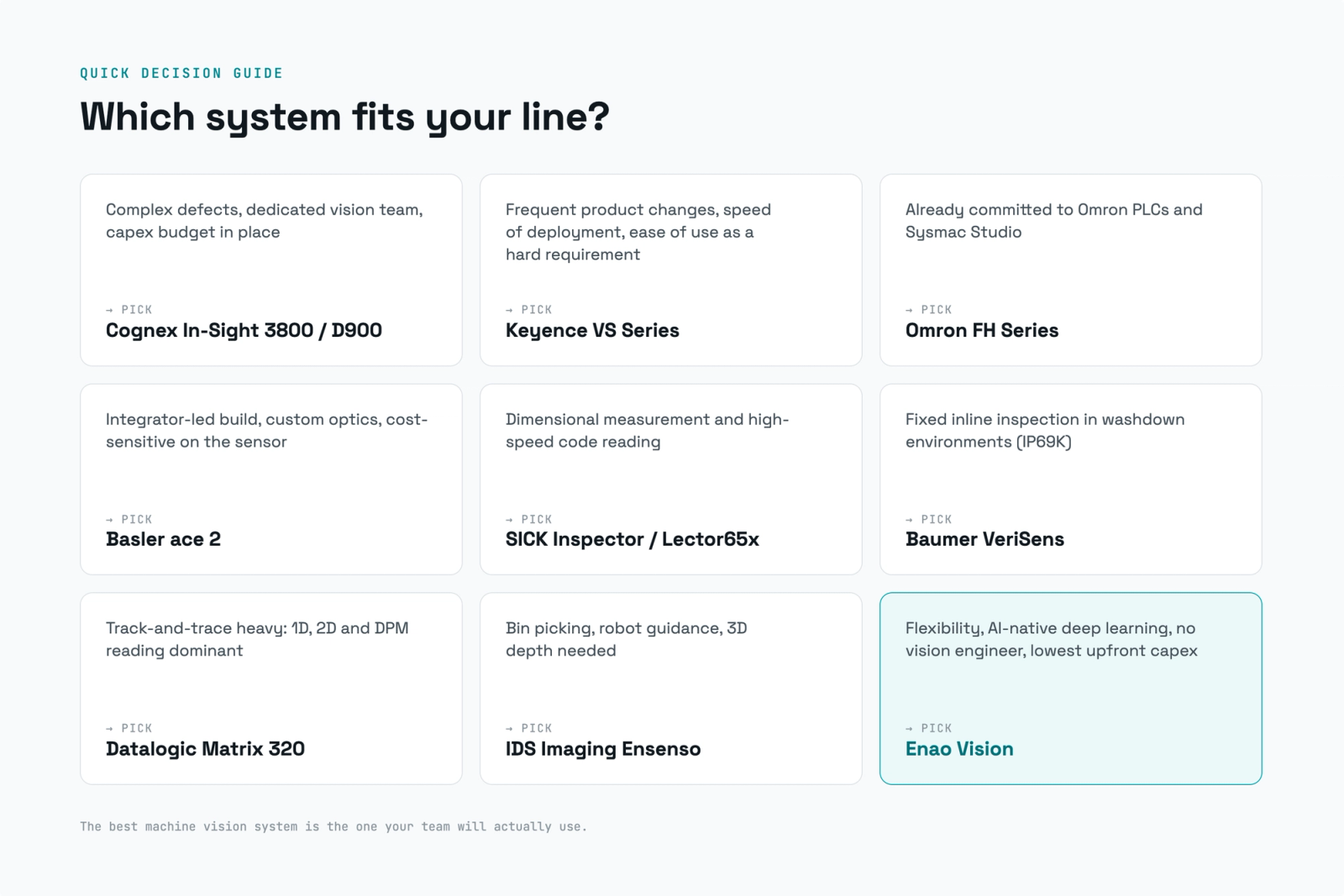
- Complex defects, large engineering team, capex budget in place: Cognex In-Sight 3800 or D900.
- Frequent product changes, need speed of deployment, ease of use as a hard requirement: Keyence VS Series.
- Already committed to Omron PLCs and Sysmac Studio: Omron FH Series.
- Integrator-led build, custom optics, cost sensitivity: Basler ace 2 with a component-based system design.
- Track-and-trace heavy, 1D/2D/DPM reading dominant: Datalogic Matrix 320.
- Bin-picking, robot guidance, 3D depth needed: IDS Imaging Ensenso.
- Retail and industrial in one vendor stack: Zebra Aurora VS40.
- Fixed inline inspection, washdown environments, rule-based: Baumer VeriSens (IP69K variant) or SICK Inspector PIM60.
- Need flexibility across mounted, handheld and macro modes, want AI-native deep learning without a dedicated vision engineer, and want the lowest upfront capex in the comparison: Enao Vision.
The best AI machine vision system is the one your team will actually use. That is worth keeping in mind before signing any capex order.
Ready to see what an iPhone can do on your line? Try the demo or get started for free with the Basic tier. Both take under a minute.
Frequently asked questions
What is the difference between a smart camera and a machine vision system?
A smart camera is a self-contained unit with a sensor, processor, machine vision software, lighting connection and I/O all in one housing. Cognex In-Sight, Keyence VS Series, Baumer VeriSens, Datalogic Matrix 320 and Zebra VS40 are smart cameras. A machine vision system is a broader term that can include a smart camera or a component camera (like Basler ace 2) paired with external lighting, processor and software. Enao Vision is a machine vision system where the smart-camera role is played by an iPhone.
How much does a machine vision system cost in 2026?
Per-camera capex ranges from around €1,500 for a component camera like Basler ace 2 up to €15,000 for a top-of-line Cognex or Keyence smart camera. Machine vision software licenses, lighting, mounts and integration typically add another €8,000 to €25,000 per line. Enao Vision inverts this: hardware stays under €1,000 per line total, and software is subscription-priced.
Which AI machine vision system needs the least training data?
Keyence markets minimal training images. Omron's self-learning tool reduces image curation. Cognex ViDi typically wants the most labeled data of the enterprise three. Enao Vision needs none upfront: the model delivers around 80 percent inspection accuracy on day one and improves as workers confirm or correct results in the app.
Can an iPhone really replace a Cognex or Keyence camera?
For sub-micron semiconductor or medical-device inspection, no. For the bulk of factory quality control (surface defects, label and print checks, presence and absence, assembly verification, packaging integrity, barcode reads, PCB visual checks), yes. A modern iPhone sensor and Enao Vision's deep learning models cover the same defect types integrated smart cameras handle, at a fraction of the hardware cost and without expert setup.
What lens options do machine vision systems offer?
Cognex and Keyence smart cameras typically integrate a fixed lens per SKU, with different SKUs for different focal lengths. Basler ace 2 uses C-mount, so any C-mount lens works. Baumer VeriSens has integrated and interchangeable-lens variants. SICK Inspector supports wide-angle lens options. Zebra VS40 uses a liquid lens for variable focus. Enao Vision uses the four native iPhone lenses (Ultra Wide 0.5× at 13 mm equivalent, Main 1× at 24 mm, Main 2× lossless crop at 48 mm, Telephoto 3× at 77 mm), all switchable in software.
How do machine vision systems connect to a PLC?
Most modern smart cameras support digital I/O plus at least one industrial protocol: EtherNet/IP, PROFINET, EtherCAT or Modbus TCP. OPC UA is increasingly standard. Cognex, Keyence and Omron all speak the common protocols. SICK and Datalogic add native support. Enao Vision uses HTTP webhooks and can also route through a gateway for OPC UA or Modbus TCP to reach PLCs, plus 24 V signal output over USB-C for direct closed-loop control.
What frame rate does a production line need?
Depends on the line speed and part size. Slow lines (below 30 parts per minute) can run at 30 FPS or lower. High-speed lines (300+ parts per minute) need 60 to 125 FPS. Most Cognex, Keyence and Omron smart cameras cover 45 to 125 FPS. Baumer VeriSens can run 100 inspections per second in high-speed mode. Enao Vision handles up to 600 products per minute on the iPhone Neural Engine.
Which machine vision system is best for barcode and QR reading?
Datalogic Matrix 320 is best-in-class for code reading, especially direct part marking (DPM). SICK Lector65x is a strong second, particularly for high-speed dynamic-focus scenarios. Cognex DataMan is another dedicated code-reader line. All enterprise smart cameras (Cognex, Keyence, Omron, Zebra) also handle standard 1D and 2D codes. Enao Vision reads 1D and 2D codes natively through the iPhone app.
What is edge learning and how is it different from deep learning?
Deep learning trains a neural network on large labeled datasets, then deploys the model for inference. Edge learning is a lighter-weight approach that trains a simple classifier on 5 to 20 example images directly on the smart camera, without cloud training. Cognex In-Sight 2800 uses edge learning. Enao Vision uses both: initial pre-trained deep learning models plus continuous fine-tuning on worker feedback.
How long does a machine vision system take to deploy?
Cognex and Omron typically take weeks with an integrator on site. Keyence trims that to days thanks to auto-configuration. Basler needs an integrator to build the full system. Baumer, SICK and Datalogic can go live in hours to days for their target applications. Enao Vision deploys in minutes per line for a process engineer who mounts the iPhone and configures the camera angle in the app.
Do machine vision systems handle 3D inspection?
Some. Cognex In-Sight L38 combines a 3D laser sensor with software for 3D inspection tasks. Omron and Keyence have dedicated 3D inspection lines. IDS Imaging Ensenso is a 3D vision technology specialist. Basler blaze 3D is a component camera option. Baumer, SICK Inspector, Datalogic Matrix and Zebra VS40 are 2D-only in their core lines. Enao Vision uses iPhone LiDAR on Pro-line devices for depth-aware inspection where useful. Choosing 3D over 2D depends on the application: robot guidance, bin picking and volumetric measurement need depth data, while surface defect detection typically does not.
Which AI machine vision system fits a small manufacturer with no dedicated engineering team?
Keyence for the enterprise route (fast deploy, strong support). Enao Vision for the software-first route (worker-configurable, subscription pricing, hardware under €1,000).
How do I keep false rejects low on a machine vision system?
False rejects (good parts flagged as defective) are the single biggest complaint on any deployed AI machine vision system. Three levers cut them: better lighting to remove ambiguity in the image, more labeled examples of "good" parts to widen the tolerance the model learns, and confidence thresholds tuned per line. Cognex ViDi and Enao Vision expose per-defect confidence sliders that let a quality manager balance false rejects against escapes. Rule-based systems require the engineer to re-tune every parameter by hand.
How does AI improve machine vision inspection?
Artificial intelligence extends machine vision from geometry checks (rule-based measurement) into pattern recognition (deep learning classification). A rule-based vision system flags parts outside a defined tolerance. An AI machine vision system built on a convolutional neural network recognizes defect types it has been trained on from images, including subtle patterns a human inspector would identify but a rule engine cannot codify. Modern computer vision models train on training data (labeled example images), then run inference at production speed on either the smart camera itself or a connected GPU. AI also enables continuous improvement: the model gets better as workers confirm or correct results, which is how modern quality control processes stay accurate through product changes and shifting supplier quality.
What industries use AI machine vision the most?
Automotive (surface defects, weld inspection, assembly verification), electronics and semiconductor assembly (solder inspection, missing components, PCB visual checks), pharmaceutical and medical device (label verification, package integrity, blister-pack completeness), food and beverage (packaging integrity, label position, fill-level checks), and consumer packaged goods (print quality, code reading, presence-absence). Machine vision applications are expanding into agriculture, logistics and life sciences as consumer hardware and deep learning push the cost floor lower.
What is the future of AI machine vision in 2026?
Three trends are reshaping the industry as Industry 4.0 and the smart factory move from concept to standard practice, with generative AI beginning to synthesize training images to augment small real-world datasets. First, deep learning is moving from cloud training to on-device inference on smart cameras and mobile devices, driven by dedicated AI accelerators like the iPhone Neural Engine. Second, cross-device fleet learning lets a fleet of cameras improve together as each one collects new training data, a capability historically limited to enterprise vision system manufacturers with cloud infrastructure. Third, consumer hardware (iPhone, Android) is entering the AI machine vision market at a fraction of legacy hardware capex, opening quality control automation and machine vision applications to mid-market manufacturers who could not previously justify a six-figure vision system project or hire a dedicated system integrator.
Do I need a system integrator to install an AI machine vision system?
Depends on the system. Cognex, Basler and IDS Imaging typically need a system integrator to combine cameras, lighting, software, PC or GPU, PLC connectivity and MES integration. Keyence and Baumer can be configured by a competent process engineer with vendor training. Enao Vision is designed to be configured by the worker on the line: a process engineer or quality manager downloads the app, mounts the iPhone and starts inspecting within an hour.
Key takeaways
Ten AI vision systems compared, one honest recommendation per fit.
- Cognex In-Sight D900, 3800 and L38 fit large manufacturers with dedicated machine vision teams and capex budgets, especially for complex defects in automotive and electronics.
- Keyence VS Series is the fastest legacy AI machine vision option to deploy thanks to integrated optics and auto-configured lighting.
- Omron FH Series is the strongest fit when the factory already runs on Omron PLCs and Sysmac Studio.
- Basler ace 2 is the go-to component industrial camera for vision system integrators building custom systems.
- SICK Inspector PIM60 and Lector65x lead on subpixel measurement and high-speed code reading.
- Baumer VeriSens covers rule-based inline inspection in washdown environments (IP69K).
- Datalogic Matrix 320 is best-in-class for code reading and DPM.
- Zebra Aurora VS40 fits manufacturers already on Zebra retail or logistics stacks.
- IDS Imaging Ensenso is the specialist for 3D depth, bin-picking and robot guidance.
- Enao Vision leads on flexibility, AI-native performance and upfront capex: hardware under €1,000, deploys in minutes, four iPhone lenses in one device, mounted, manual-station and handheld modes, IP68 out of the box, no integrator required.
Related reading
- Industrial image processing: a working guide for factory teams
- Machine vision inspection: what it is, what it costs and when to use it
- Machine vision systems in 2026: types, architectures and how to pick
- How small a defect and how big a product can one iPhone actually inspect?
Get started
Want to see how Enao Vision handles your inspection? Try the demo to watch an iPhone inspect a live video feed in your browser (no signup, no email, sixty seconds), or get started for free with the Basic tier and mount an iPhone on your own line today.
Explore with AI
Discuss this article with your favorite AI assistant
