What is AI visual inspection? A practical 2026 definition

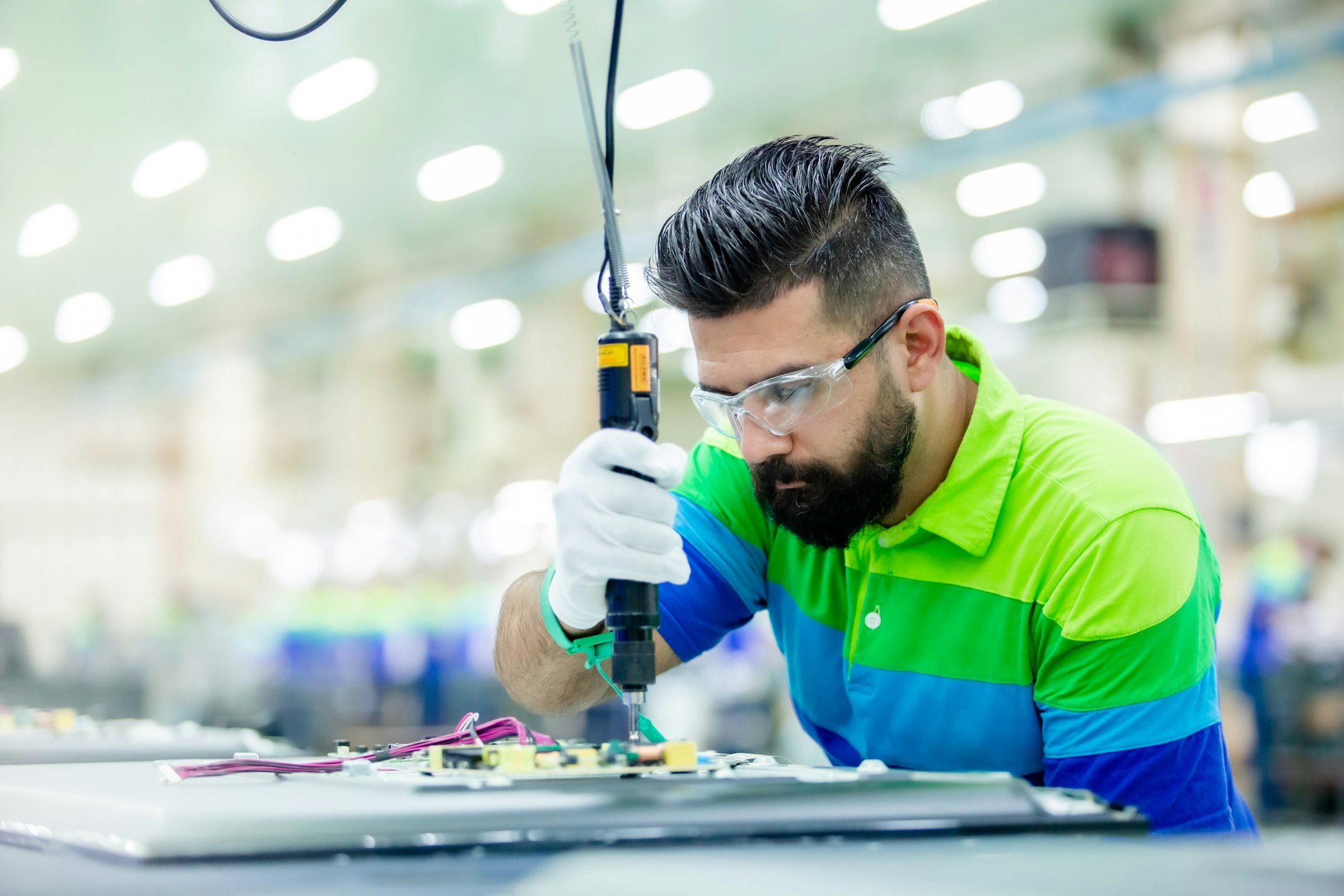
AI visual inspection is the use of artificial intelligence and machine learning algorithms to automate defect detection and quality control on a production line. A camera captures an image, an AI-powered model classifies what it sees in real-time, and the line passes the part, rejects it, or routes it for review. The shift away from rule-based machine vision is that the model learns from labelled datasets rather than from hand-coded rules, so it handles the variation real factories produce: cosmetic flaws, subtle assembly errors, surface anomalies, and packaging mistakes a fixed threshold would miss.
The category sits inside computer vision and is sometimes called automated visual inspection, AI-based visual inspection, ai-driven quality inspection, or smart inspection. What changed in the last few years is that pre-trained AI models, smartphone cameras, and cheap compute now make these AI systems realistic for small and mid-sized manufacturers, not just Fortune-500 plants.
This guide explains what the technology is, how it works in practice, where it beats traditional machine vision and manual inspection, and how to know if your line is ready. It is written for quality engineers and plant managers who want a clear definition of these inspection systems before evaluating vendors or running a pilot.
How does AI visual inspection improve quality control?
Quality control teams have used cameras on production lines for decades, but until recently the inspection process was either humans squinting at parts under a lamp or rule-based vision systems matching pixel patterns to fixed thresholds. AI changes the equation. An AI-powered inspection system runs the same trained algorithms on every part, around the clock, at the same precision the model showed on day one. Manual inspection delivers around 70-90% catch rates over an 8-hour shift, and accuracy drops sharply at hour seven; an AI inspection system holds its level. That is the practical reason quality control teams switch to ai-powered visual inspection: scalability of consistent attention across long shifts, multiple production lines, and mixed product runs, with no fatigue-driven downtime.
A second contribution is data. Every inspection produces a logged inspection result with image, verdict, and confidence. Over months, that inspection data becomes a quality dataset you can mine for trends: which defect types are increasing, which line speeds correlate with cosmetic flaws, which suppliers cluster around which failure modes. Quality teams that adopt AI inspection treat it as a process-improvement tool to optimize throughput and product quality, not just a defect filter.
How does AI visual inspection work in practice?
On the floor, the system runs as a tight loop between a camera, a trained model, and the rest of the line's automation. The camera captures a frame as each part passes a fixed station. The model receives the image, runs inference, and returns a verdict in milliseconds: pass, fail, or unsure. If pass, the part continues. If fail, the part is diverted into a reject bin or flagged for an operator. If unsure, most teams route the part to a human and feed that decision back into the next round of training data. Automation makes this loop fast enough to keep up with line rate.
The training side runs in parallel. A quality engineer collects images of good parts and bad parts, labels them by defect type, and uses that dataset to teach a neural network what to look for. Modern training tools handle the heavy lifting through transfer learning: instead of training from scratch, you start from a pre-trained vision backbone and fine-tune it with a few hundred to a few thousand factory images. The whole inspection process, from first image collection to a working AI inspection system on the line, is a matter of weeks.
What hardware do you actually need?
The hardware footprint is much smaller than most people expect. A modern smartphone with a good camera plus a basic LED ring light is enough to inspect a wide range of small parts at full line rate. For larger parts or harsher environments, an industrial camera with a fixed lens and controlled lighting is still useful, but the compute fits on the same phone or on a small edge box. You do not need a server rack, a GPU cluster, or a dedicated network drop; an iPhone handles real-time inference for most defect classes under €1,000 of total hardware. Even on high-speed lines, careful camera selection and lighting design usually matter more than raw compute.
How accurate is AI visual inspection?
Modern AI inspection systems hit 95-99% true positive rates with false positive rates under 1% once the model has seen 200-500 labelled examples per defect class. Accuracy depends on lighting, image consistency, and how cleanly the defect classes are defined. Most teams set precision and recall targets, measure inspection results against a held-out test set, and roll out to production only when the model meets both numbers.
How is AI visual inspection different from traditional machine vision?
Traditional machine vision uses hand-coded rules and pixel-matching algorithms to decide whether a part is good or bad. An engineer measures a feature, sets a threshold, and the system flags any image outside that threshold. This works for clean, repeatable inspections like measuring a hole diameter or reading a barcode. It works poorly for variation: lighting changes, fixture drift, parts with subtle cosmetic defects, or any inspection where the failure mode is not a single measurable feature. It also struggles when the manufacturing process introduces new products every few weeks.
AI visual inspection inverts that approach. Instead of writing rules, you show the system many examples of good parts and bad parts, and the model learns the boundary itself from the dataset. The trade-off is that you need labelled training data, and the model is harder to inspect than a fixed rule set. The benefit is that the AI-powered system handles variation gracefully, generalises to new defect types when you keep training, and catches subtle multi-feature defects no engineer could write a clean rule for. Most modern lines use both: traditional vision systems for measurements, AI for cosmetic and complex defects.
When should you choose AI over traditional machine vision?
Pick ai-powered visual inspection when defects are visual but not measurable, when you have many short-run product variants, when lighting is hard to lock down, or when scalability across product families matters. Stick with traditional machine vision for clean dimensional or barcode checks, when speed pressure is extreme and you need sub-millisecond decisions, or when regulatory frameworks require a deterministic, rule-traceable inspection chain. Many quality teams now run a hybrid: AI for surface, dent, and assembly classes, traditional vision for everything geometric.
What types of AI models are used in visual inspection?
Three model families do most of the work. Convolutional neural networks (CNNs) are the workhorse algorithms: they classify whole images, detect objects, and segment defect regions pixel by pixel. Vision transformers, a newer family of deep learning algorithms, beat CNNs on certain inspection tasks, especially when training data is limited. Anomaly detection models, which learn what good parts look like and flag anything different, fill the gap when you have very few examples of failure. Most production AI systems combine two or more algorithms in a single pipeline, with datasets sized to each task.
Classification, detection, and segmentation
Classification answers a yes-or-no question about a whole image: is this part good or bad? Object detection draws a box around the defect: there is a scratch here, of size X, at this location. Segmentation goes pixel by pixel and tells you which pixels belong to the defect. Most production lines start with classification because it is cheapest to label, then add detection or segmentation when they need to localise defects for root-cause analysis or to drive an automated rework station.
What defects does AI visual inspection catch best?
The technology is strongest on defects humans can see but rule-based systems struggle to formalise. Cosmetic defects on consumer-facing surfaces, subtle assembly errors, missing or misplaced components, and surface anomalies on textured materials are good fits. Common defect types in production deployments include:
- Surface defects on metal, plastic, and ceramic parts: scratches, dents, cracks, pits, rust, contamination.
- Cosmetic defects on consumer goods: discoloration, gloss variation, print defects, label misalignment.
- Assembly defects: missing screws, missing components, wrong component, misorientation, wrong colour.
- Packaging defects: torn film, missing seals, misprinted lot codes, wrong label, missing inserts.
- Food and beverage defects: foreign objects, fill-level errors, cap orientation, expiry-date legibility.
Where does AI visual inspection work well across industries?
Industries with the strongest ROI share one trait: high-mix or high-volume production with cosmetic or assembly quality stakes that humans currently inspect by eye. Common use cases include automotive component plants, electronics manufacturing, food and beverage packaging, pharmaceutical packaging, ceramics, and consumer goods.
Automotive and electronics manufacturing
Automotive component lines deploy AI to catch surface defects on stamped or moulded parts, weld quality on assembly nodes, missing fasteners, and engine seal positioning. Many automotive plants run several visual inspection systems on a single line because the cost of an escape on a safety-critical part is high. Electronics manufacturing uses computer vision to catch missing or wrong components on printed circuit board assemblies, solder bridge anomalies, and final cosmetic checks. PCB inspection in particular fits AI well because components are small, the defect catalogue is large, and the human eye tires quickly. In both industries, the technology slots into existing 100% inspection stations and either replaces or supports human inspectors who would miss subtle defects on long shifts. Some plants pair this with predictive maintenance signals so robots and ai systems share a common quality picture.
Food, beverage, and pharma
Food and beverage packaging lines verify fill levels, cap and seal integrity, label placement, and expiry-date legibility. Pharmaceutical packaging deploys it on blister packs, vial inspection, label print quality, and tamper-evident seal checks where regulatory traceability matters. These deployments often pair the AI model with a traceability log so every reject can be reviewed downstream, which is also where ai-powered inspection solutions shine.
How do you deploy AI visual inspection on a line?
A clean deployment splits the inspection process into five phases. Phase one is scoping: pick one inspection station, define defect classes, agree on accuracy targets. Phase two is data collection: capture a few hundred good and bad images per defect class and label them. The quality of these datasets sets the ceiling on the model's performance. Phase three is training and validation: fine-tune a pre-trained model and iterate until accuracy targets are met. Phase four is integration: connect the model to a camera, set up the verdict signal, run in shadow mode while operators continue inspecting. Phase five is rollout and monitoring: switch the model into the live role, set up monitoring on its outputs, schedule periodic re-training as new products evolve. Scalability beyond the first station then comes down to repeating phases two through five for the next line.
How much training data do I need?
For most defect classes, 200 to 500 labelled examples per class is enough to reach production quality. Anomaly detection deployments can start with just 100-200 good-part images and add labelled defects later to refine the boundary. With less than 100 examples, you can still ship by augmenting the dataset, but expect a longer ramp.
Can AI visual inspection run on a smartphone?
Yes, and for many use cases that is the most cost-effective option. A modern iPhone runs the camera, the model, and the verdict logic on-device with no cloud round-trip. Total hardware stays under €1,000 (refurbished iPhone, ring light, mount, cables) and you get a portable inspection station you can move between lines. Apple's Neural Engine is fast enough to run modern computer vision models at line rate, which is why iPhone-based AI inspection is now a viable alternative to industrial smart cameras for most SME factories.
How do you measure ROI on AI visual inspection?
ROI comes from three places: scrap and rework reduction, freed-up inspector time, and reduced field returns. On most pilot lines, the dominant savings come from catching defects earlier, which avoids downstream rework cost and reduces finished goods scrap. Both effects show up in product quality metrics and in cost-of-poor-quality dashboards within the first quarter. A simple ROI model multiplies your current cost of poor quality by an expected reduction percentage and compares against the all-in cost of the AI system over three years. Most pilots target a 30-60% reduction in escapes and a 20-40% reduction in inspection labour during the first year, with payback inside 6-12 months on smartphone-based deployments.
How do you know you are ready?
A line is ready when the following are true:
- One quality station has visual defects that are hard to formalise as rules, and current scrap or rework cost is meaningful.
- Operators can capture a few hundred images of good and bad parts without stopping production processes.
- Defect classes are defined clearly enough that two inspectors would agree on each case.
- Lighting and part presentation can be made consistent enough that the camera sees roughly the same thing each cycle.
- Someone owns quality control outcomes and can switch the model from shadow mode to live inspection.
If three or more are true, a pilot is realistic. The technology is rarely the limiting factor; data quality and clear ownership are.
Frequently asked questions
How does AI compare to manual inspection?
Manual inspection delivers around 70-90% catch rates in the first hours of a shift and drops as fatigue sets in. An ai-powered inspection system holds its precision throughout the shift, runs the same algorithms on every shift, and produces a logged inspection result for every part. Most teams that adopt AI redeploy human inspectors to ambiguous parts and root-cause analysis, augmenting them rather than replacing them.
Is AI visual inspection regulated?
The technology itself is not specifically regulated, but the inspection it replaces may be. In pharma, medical devices, and aerospace, traceability and validation rules apply to any quality decision the model makes, so deployments require formal validation, change control, and audit trails.
How do I avoid false positives in production?
False positives drop quickly once the model has seen 100-200 examples of edge cases, such as clean reflections or normal grain in cast parts. After the first month, false-positive rates typically settle below 1%.
Can the model learn new defect types?
Yes. When a new defect class appears, you collect a few dozen examples, retrain the model, and redeploy. Most modern AI inspection platforms automate this update cycle and embed it into the standard quality workflow. This is one of the clearest benefits of ai over rule-based vision.
Where Enao Vision fits
Enao Vision packages AI visual inspection so a small operations team can deploy it on one production line without bringing in a data scientist. An iPhone runs as the camera and the inference engine. The team collects images on-device, labels them, trains the model, and deploys it back to the same phone. The hardware footprint stays under €1,000 (refurbished iPhone, ring light, cables, mount), and the model can be retrained whenever a new defect class appears.
The trade-off is positioning, not capability. Enao is built for small and mid-sized manufacturers who would otherwise be shut out of AI visual inspection because the industrial-camera total cost of ownership does not pencil out at their volumes. For every line below that threshold, the iPhone approach is now the cheapest path to a working AI inspection system.
Key takeaways
- AI visual inspection uses artificial intelligence and machine learning algorithms to automate defect detection and quality control, replacing or augmenting hand-coded machine vision rules.
- It is strongest on cosmetic, assembly, and packaging defects where humans can see the problem but a fixed rule cannot easily formalise it, and where manual inspection accuracy drops over a long shift.
- Modern smartphone-grade cameras and pre-trained ai technology bring total hardware cost under €1,000 for most defect classes, opening AI inspection to small and mid-sized manufacturers.
- A clean deployment runs in five phases: scope, data, train, integrate, monitor. Each takes days to weeks, and the inspection process is repeatable for the next line once the first one is live.
- Most pilots see 30-60% defect-escape reduction and 20-40% inspection labour reduction in the first year, with payback inside 6-12 months on smartphone-based AI inspection systems.
Get started
Want to see how Enao Vision works on your line? You can get started for free using an iPhone you already have, or try the demo to compare notes with other quality and operations teams putting AI on the shopfloor.
Explore with AI
Discuss this article with your favorite AI assistant
