AI visual inspection for automotive body-in-white

Warranty claims from body-in-white defects are a small but material slice of total first-three-month claims. At a Tier-1 OEM volume of around 400,000 vehicles a year, even a fraction of a point per 100 vehicles translates into tens of millions of euros of warranty exposure annually, per J.D. Power and similar industry tracking.
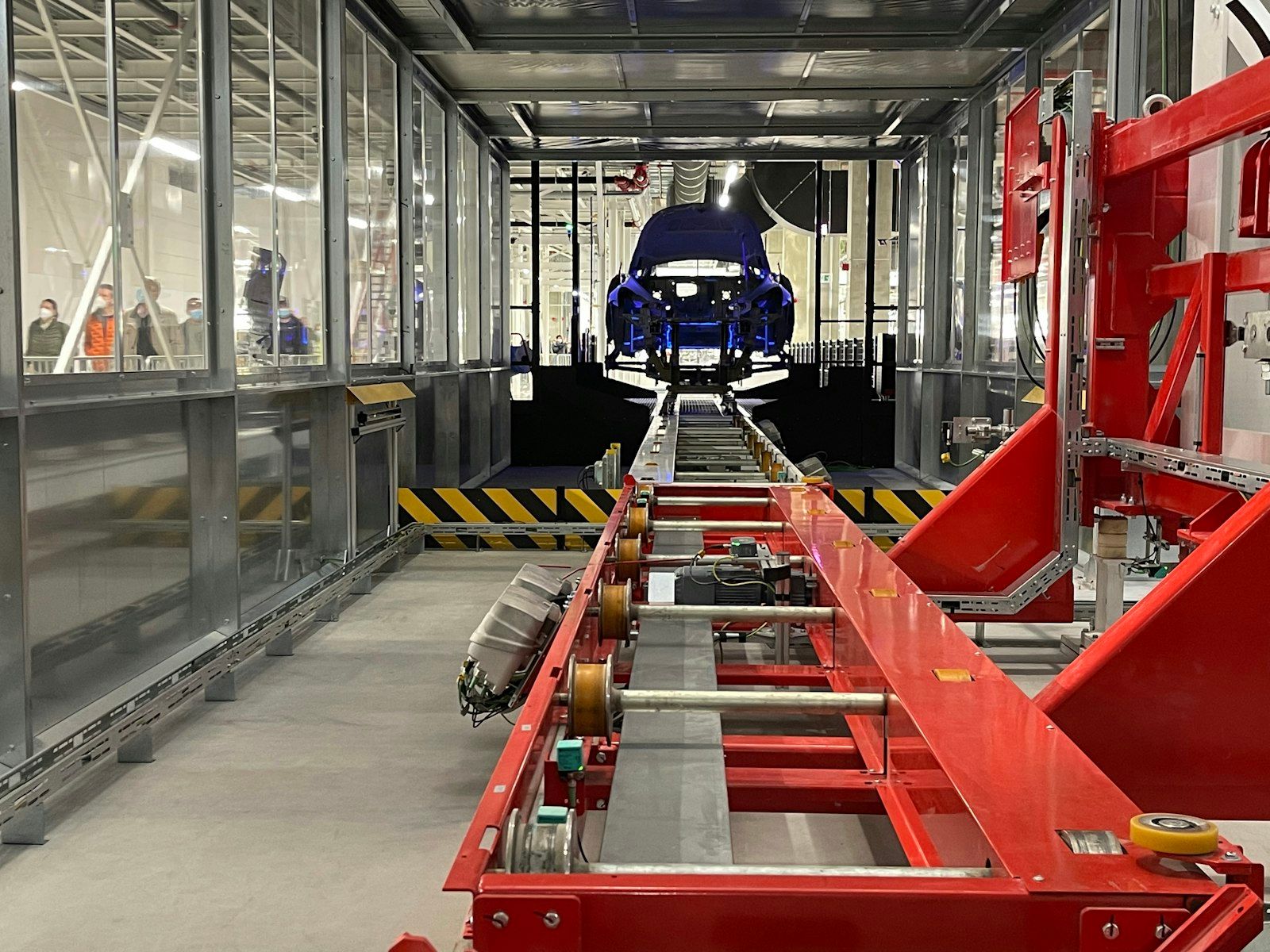
Body-in-white, or BIW, is the stage where raw stamped panels become a welded, sealed, and gap-checked body. It is also where the most expensive defects are born. Miss a cold-lap spot weld at BIW and the warranty claim arrives at month 11 when the panel lets water in.
BIW inspection scope
Four inspection tasks run concurrently in a modern BIW cell. Spot weld verification checks that every one of the 4,000 to 6,000 welds per body landed correctly. Sealant bead inspection confirms continuous application at the panel seams. Panel gap measurement checks the flush between adjacent panels. And cosmetic inspection catches dents, scratches, and stamping artifacts before the body moves to paint.
Most plants handle two or three of these tasks with dedicated stations. The remaining one or two still go to manual inspection, with the recall statistics to show for it.
Robot-mounted vs fixed-station AI inspection
Robot-mounted cameras ride the same fixtures that carry the welding torches. One mount position, many inspection poses. That is the right architecture for spot weld verification because the camera reaches into corners that a fixed station cannot see.
Fixed stations win for sealant bead and cosmetic checks because the body is stationary for long enough to capture the full envelope. Panel gap measurement works on either, depending on the line layout.
AI changes the tradeoff in one way. On both architectures, the same model architecture generalises across vehicle variants. In the old rule-based world, a new model year meant rewriting recipes for every station. With AI, it is a retrain on a few hundred images per variant.
Weld defects AI can catch
Porosity shows up as surface pin-holes. Cold lap is a weld that did not fuse to the parent metal; the visual tell is a crisp edge where a heat-affected zone should be. Burn-through is a hole where the weld pool ate through the panel. Under-sized welds are welds where the nugget is below the spec diameter.
All four are visually subtle. A human inspector on a station after 1,200 welds per hour misses a meaningful share. An AI model trained on 2,000 to 5,000 good and bad examples per class holds stable accuracy across the shift.
Panel gap and flush vs laser triangulation
Laser triangulation is the incumbent for panel gap. It is accurate, expensive per sensor, and constrained to the geometry it was calibrated for. AI visual inspection from a single camera can measure gap and flush to within 0.1 millimetres for most body panels, at a fraction of the sensor cost.
Where laser still wins: tight-tolerance panels below 0.05 millimetre flush spec, and mirror-finish surfaces where stereo vision struggles. For the broader range of BIW panel gap tasks, AI vision is enough and cheaper.
Integrating with plant MES and SPC
Every BIW inspection result has to land in the Manufacturing Execution System with a timestamp and a vehicle VIN. It also has to feed Statistical Process Control dashboards that catch drift before defects hit the line.
This integration is where most AI vendors stumble. Modern platforms ship with OPC UA and REST adapters out of the box, so the MES integration takes hours rather than weeks.
For deeper context, our AI weld inspection deep dive covers the weld-specific defect classes. See the vendor comparison for tradeoffs by supplier and end-of-line QC for what happens at paint exit.
Enao Vision deploys two-model workflows on a single iPhone per station: anomaly detection for the long tail of cosmetic defects and defect detection for the six AWS weld classes. The Bridge module syncs two or three iPhones in a robot cell when coverage requires it. Compared with dedicated laser triangulation, the system typically lands at a fraction of the per-station cost.
BIW is the most expensive quality station in an automotive plant. It is also the one with the longest tail of defects that humans miss at the pace the line runs. Every point of warranty claim rate prevented pays for an AI rollout inside the quarter.
Running BIW inspection, spot-weld QC or working through a laser-to-AI comparison? Compare notes with other teams in our community.
