Automated Visual Inspection: Keyence IV4 vs iPhone, 5 Bottle Types
Label presence and alignment, straight from Keyence's own IV4 page. Five Fritz-Limos, trained on three, tested on two neither device had seen before.
After our surface defect video, the Keyence team pointed out that the IV4 is a vision sensor built for presence and absence, not defect inspection. So this time we met it on its home ground: label presence checking and misalignment detection, an application listed on Keyence's own IV4 page.
We bought five Fritz-Limos in different colors with different caps and labels, removed two labels and knocked two more crooked. Both devices were trained on three bottles, a good original cola, a grapefruit with a missing label and an apple spritzer with a misaligned label, then tested on two bottles neither had seen: an orange with no label and a Cola Light with a misaligned label.
On the Keyence we used AI Check with three master images. Setup was quick, and it caught the missing label on the unseen orange, but it passed the misaligned Cola Light as good. On the iPhone we labeled 57 images in about ten minutes. It flagged all four defective bottles and passed the good one, both handheld and in production line mode, with occasional false picks on the background.
To be fair to the sensor, the iPhone saw more training images, and a vision engineer with more time would get more out of the IV4. The test is about what you get from each device in roughly the same short setup time.
動画の文字起こし
Is this another Berlin crime movie? Of course not. Today we are testing visual inspection of bottle labels. Keyence IV4 versus iPhone, five Fritz-Limos in five colors. Is the label misaligned, or is it missing? Three colors to train, two to evaluate performance.
Last time we posted our video on iPhone versus Keyence IV4 for surface defect detection on LinkedIn, and we got a note from the Keyence team that the IV4 is a vision sensor designed for presence and absence detection, not defect inspection. That is a strong statement if you look at the Keyence IV4 website, where the claim word for word is: by registering just a single image, stable detection can be ensured regardless of environmental changes or individual product variations. That is essentially what we tested last time.
Anyway, we wanted to post a sequel and meet the IV4 on one of its home grounds, an application specifically listed on the Keyence IV4 website: label presence checking and misalignment detection. So we check whether the label is there, whether it is missing, or whether it is misaligned.
We went to our favorite Berlin Späti and bought five Fritz-Limos in different colors with different labels. We removed the labels from two bottles, made some of the others misaligned, and set up the Keyence IV4 next to the iPhone to test exactly this use case. Automated visual inspection, Keyence IV4 versus iPhone, on five bottle types.
The test setup has both sensors lined up at around one meter from the bottles. The Keyence sensor we bought has what Keyence calls a normal lens, which compared to the iPhone is roughly a 2x tele lens, so we activated the 2x lens on the iPhone and placed it about a meter away as well. There are other versions of the Keyence sensor if you want to work closer to or further from the product. On the left we have the lemonades and colas and a small conveyor belt, so this is a conveyor test, and we have to be a bit careful not to knock the bottles over.
We have five bottles, all different colors, all different caps, even the colas with and without sugar have different caps and labels. For training we use the classic original Fritz-Kola as the good product. The grapefruit with the missing label goes into the training set as a bad product, and the German Apfelschorle, apple juice with sparkling water, goes into the training set with a misaligned label. So the training set is one good product, one bad product with a missing label, and one bad product with a misaligned label.
The test set is the orange flavor without a label, and the Cola with no sugar, which is essentially the same bottle as the original with artificial sweetener, with a misaligned label. These go into the test set, so neither device is trained on them.
We start with the Keyence sensor. The first thing I struggled with was getting good images when the sun shone directly into the setup, so I lowered the shutters to keep the sun out. Then I got decent images using the Keyence intelligent image optimization, where you mark the area you want to inspect and choose the image you like best.
Then I used the AI Check tool. AI Check registers a good product, then I registered a bad product with the misaligned label, and then the defective product with the missing label. That is it, so setup with the sensor is quick, registering these three as master images for good and bad examples. Then we ran the conveyor belt and let all five bottles pass the sensor.
It classifies the products it has seen correctly, but it already struggles with the products it has not seen. The black bottle with the misaligned label was classified as good. It worked for the orange flavor, which looks similar to the grapefruit flavor it was trained on. To get this sensor running stably across all your product variations, different bottle colors, different label colors, different kinds of misalignment, you would definitely need to register more than three examples, probably a good and a bad example for every product variation.
Now the iPhone. We start again by taking images of the three training products and labeling them. Overall I labeled 57 examples, and it took around ten minutes. I included variation, different positions and angles, sometimes holding the bottles in my hand and sometimes standing on the conveyor, to make the training robust.
The nice thing about the iPhone is that after training we can evaluate it in handheld mode, holding the iPhone against the defective products to see whether it works. It sometimes picks up a bit on the background, so it is not perfectly stable, but overall it is impressive that with so few examples it classifies all four bottles as defective and leaves out the good one, as it should. Very stable performance with very little training effort.
To make the comparison equal we also switched on production line mode and let the bottles pass the iPhone. It tracks the defects on the video stream and selects one image to report back to the system.
I hope you liked this video. I am feeling a bit like a caveman in here even though it is not winter yet, the shutters are already down, but it is good that I have my reservoir of Fritz-Kolas to keep me going. If you want to see more about using the iPhone as an industrial sensor, check out our YouTube channel. See you next time.
次に見る
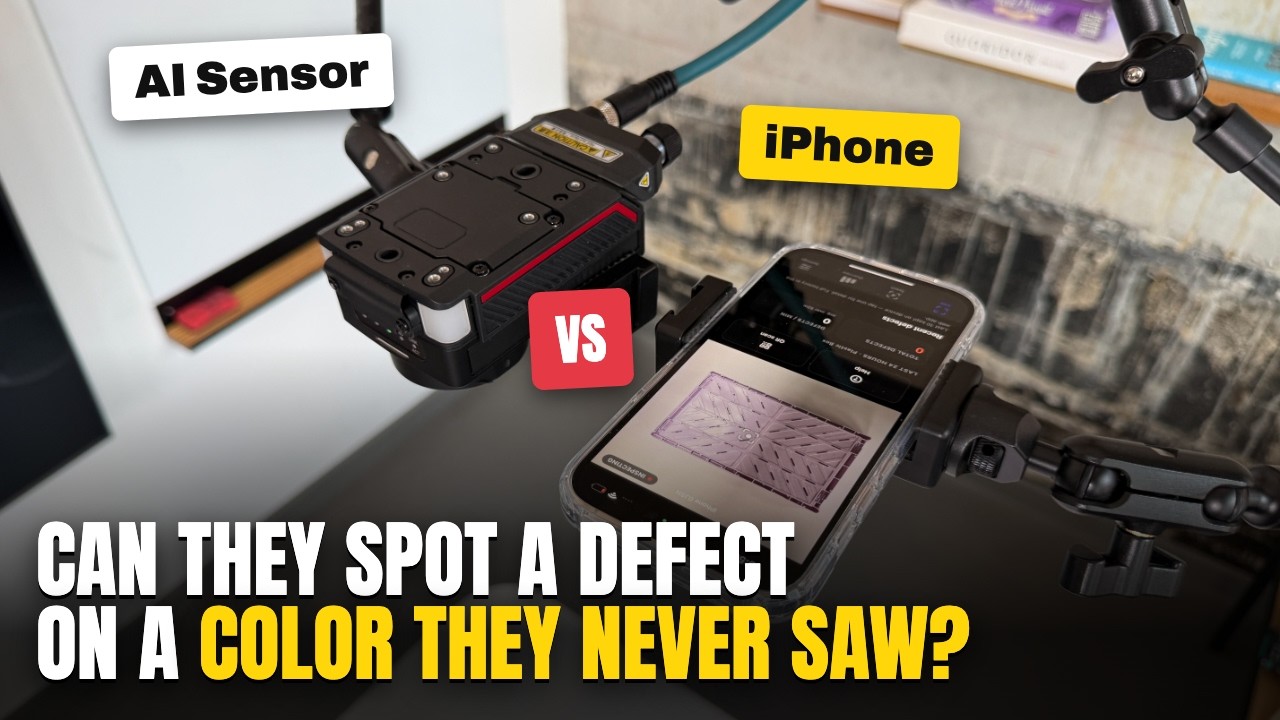
Surface Defect Detection: Keyence IV4 vs iPhone
A Keyence IV4 and an iPhone trained on the same injection molding defect, then tested on a color neither had seen. Teaching speed vs detection performance.
公開日 2026年9月11日
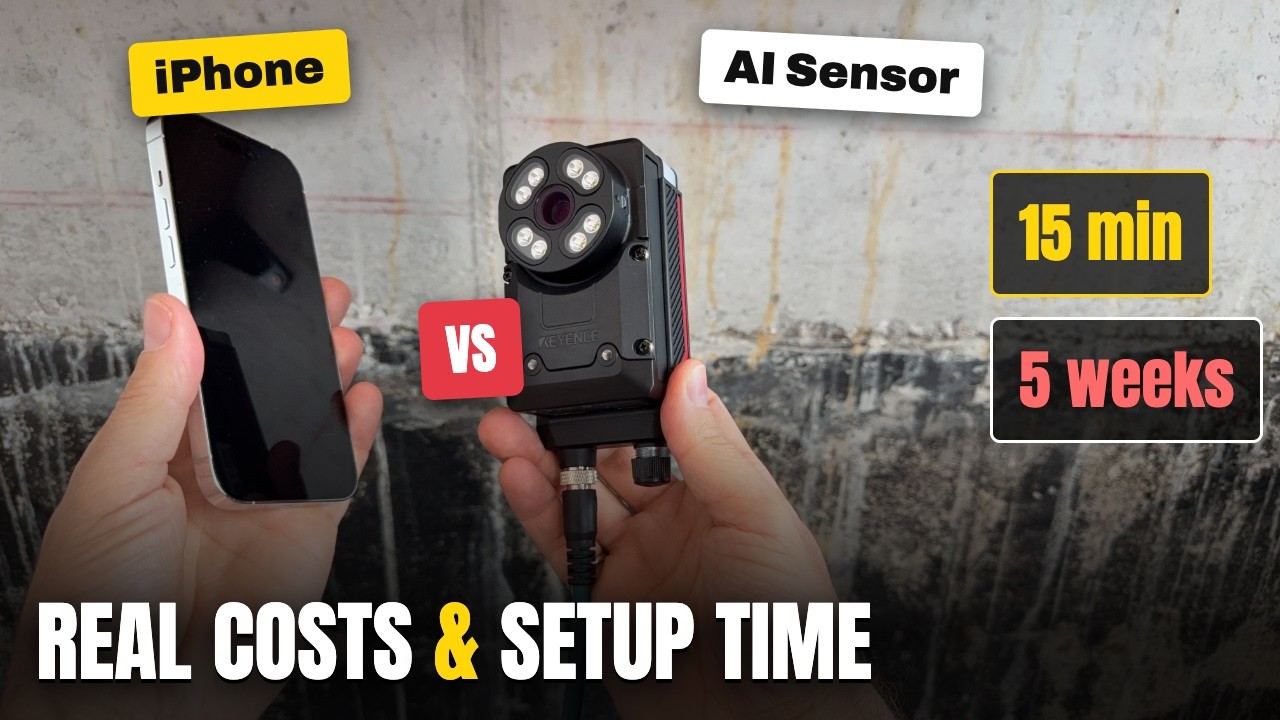
AI Vision Systems: Real Costs and Time to First Result
We bought a Keyence IV4 and tracked every euro and every day to a first image, then ran the same test on an iPhone. Here is what each one really costs.
公開日 2026年9月1日
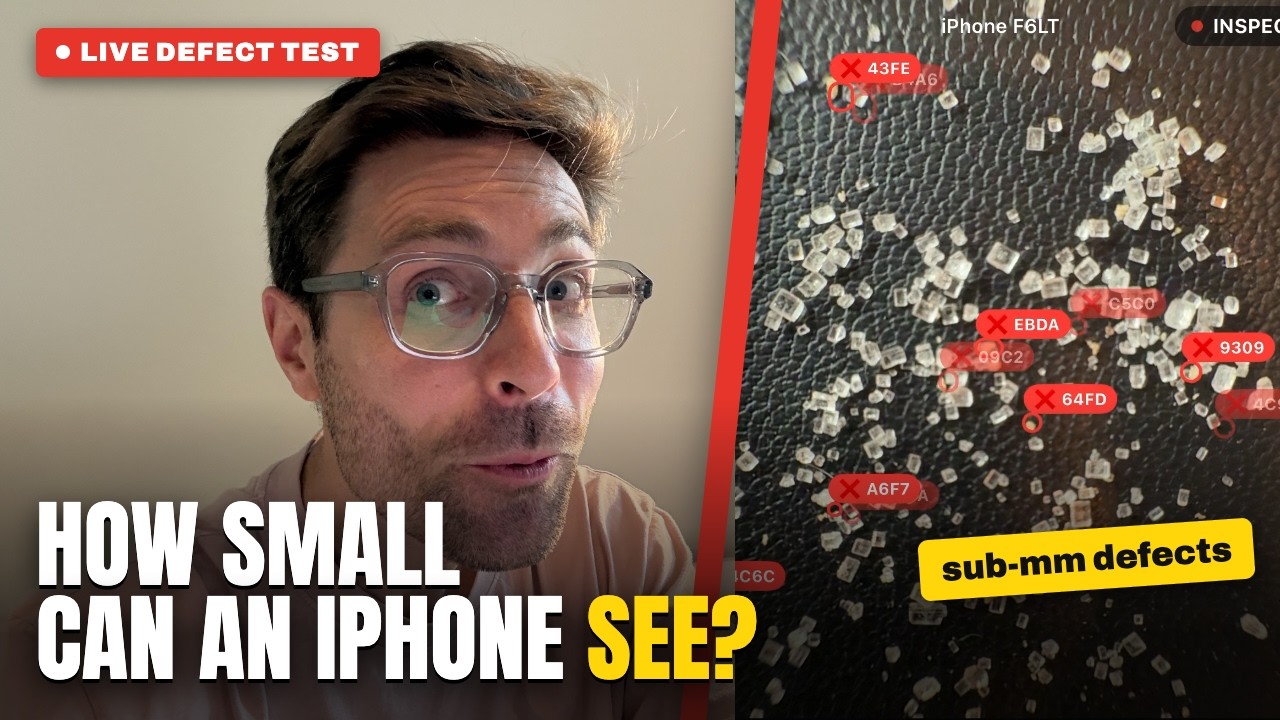
How Small a Defect Can an iPhone Detect? Sub-Millimetre Sugar Test
Two piles of sugar, one contaminated with sub-millimetre foreign material. We tested whether an iPhone Ultra Wide macro lens catches what the eye misses.
公開日 2026年7月31日
新しい検査解説動画をチャンネル登録で
数週間ごとに、iPhone 検査ステーションの設置、実際の部品でのモデル学習、現場での結果確認をテーマにした新しい動画を公開しています。YouTube でチャンネル登録すると、いち早くご覧いただけます。