Ceramic Tiles
Automated quality inspection for ceramic tile lines, on an iPhone.
On a ceramic tile line running 6,000 to 12,000 m² per shift, every escape costs you twice. A glaze pinhole the size of a peppercorn, a decor that drifted half a millimetre, an edge chip nobody catches until the tile is on the wall. Enao watches the line on a refurbished iPhone and flags defective tiles in real time.
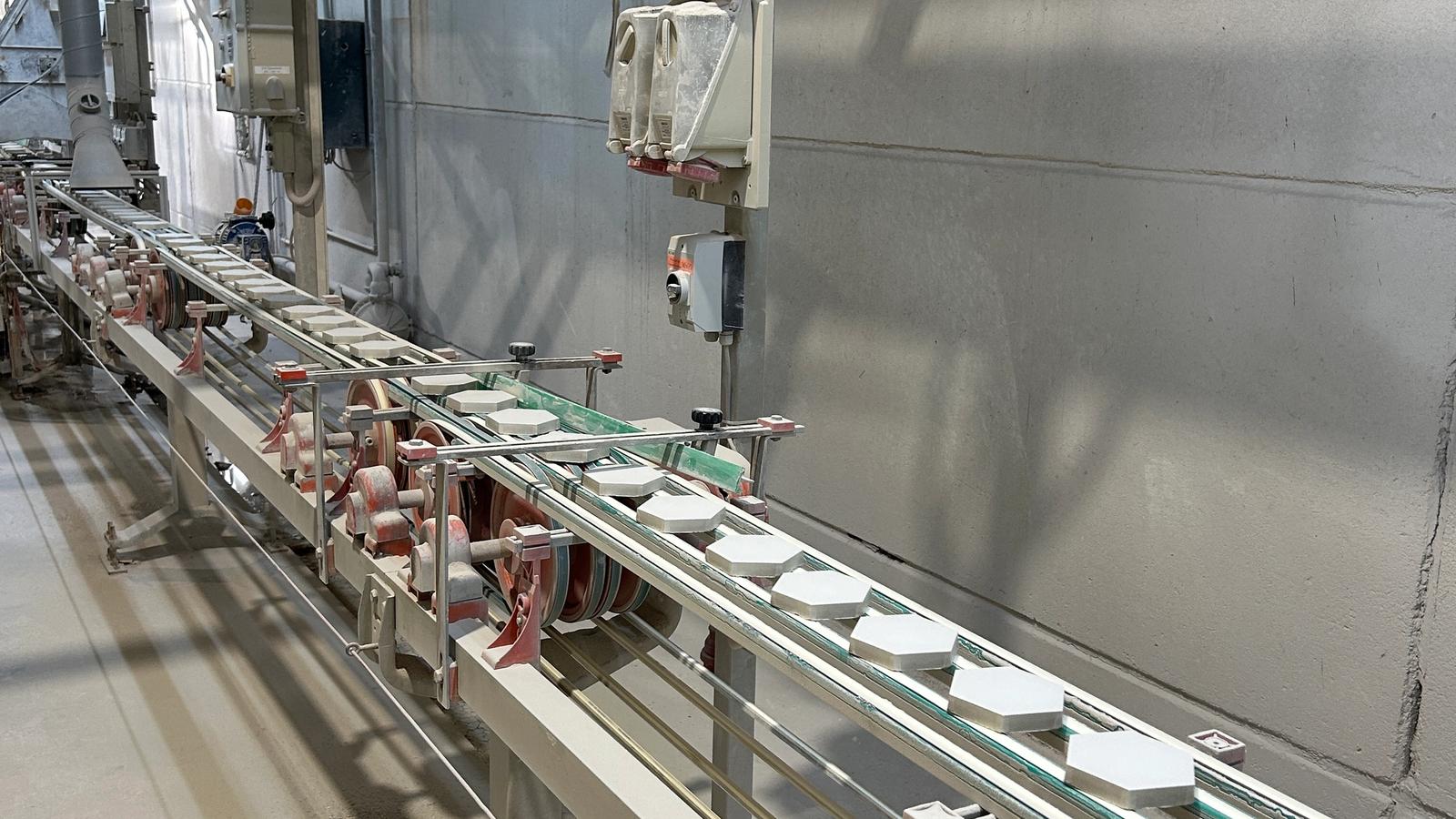
A glaze pinhole the size of a peppercorn, a decor pattern that drifted half a millimetre during a colour change, a chipped edge that nobody noticed until the tile was already palletised. On a ceramic tile line running 6,000 to 12,000 m² per shift, every escape costs you twice. First the tile leaves the plant. Then a contractor finds it on the wall, calls the buyer, and a whole pallet comes back. Manual sorters catch most of it, but they fade after the third hour, and they cannot be trained fast enough when a new decor goes into rotation. Automated quality inspection for ceramic tiles is what closes that gap, and it does not need a six-figure vision platform to do it.
What is automated quality inspection for ceramic tiles?
Automated quality inspection for ceramic tiles is the use of cameras and AI vision models to watch the tile line and flag defective pieces in real time, before they reach packaging. The system replaces the second pair of eyes that used to stand at the sorter and gives the line a consistent quality benchmark across shifts and decors. What makes the ceramic tile domain specific is the surface itself: glazed tiles reflect light differently from porcelain bodies, decor printing creates pattern noise that simple rule-based vision struggles to separate from real defects, and high-throughput continuous belts demand line-scan capture that stays in sync with belt speed.
AI-led inspection beats both manual checking and traditional rule-based vision because the model learns what your specific decors and glaze finishes look like, and it adapts when you launch a new collection without anyone re-programming the rule set. AI defect detection for ceramic tiles has moved from pilot status to standard practice on new tile lines, and the gap between AI-led inspection and the manual sorter widens with every new collection a producer launches.
Defects we catch on ceramic tile lines
Glaze pinholes
Tiny gas-bubble craters that pop during firing and leave a visible black or white speck on the glazed surface. They appear randomly, often clustered around a single mould, and a human grader misses them once fatigue sets in. Enao's model picks up on the local texture irregularity and the shadow signature under diffuse dome lighting, even on dark glazes where contrast is weakest.
Color drift between batches
The decor or body colour shifts by a few delta-E points between firing runs, sometimes within a single day. The drift is invisible piece by piece but obvious when two batches end up on the same wall. The model holds a colour reference per SKU and flags drift before a full pallet ships under the wrong tone.
Edge chips
Small fractures along the cut edge, usually caused by a worn diamond blade or a misaligned conveyor transfer. They are easy to miss in the visual chaos of a moving belt. The model watches the four edges of every tile and flags the local discontinuity, including chips that sit on the underside chamfer where a top-down inspector cannot see them.
Surface cracks
Hairline cracks across the body, often radiating from a corner or following a stress line in the press. They become visible only at certain angles. Grazing light from the side surfaces them clearly to the camera, and the model scores the crack length and orientation so the line can route severe pieces to scrap and minor pieces to second-quality.
Print and decor misalignment
The decor pattern shifts off-register by one to two millimetres, leaving a visible mismatch on rectified tiles where the eye expects perfect grid alignment. Manual graders spot the worst cases but pass the marginal ones. The model compares the decor against a master image per SKU and catches sub-millimetre drift consistently.
Caliber and size deviation
Out-of-tolerance length, width, or diagonal that pushes the tile outside its commercial caliber bin. Traditionally measured downstream by a dedicated calibrating station. The vision model adds a check at the inspection point so caliber-flagged tiles get rejected upstream rather than after the costly sorter.
The lighting setup that makes this work on a ceramic tile line is a diffuse dome or coaxial lamp that neutralises the specular glare on glazed surfaces. For high-throughput continuous belts a line-scan configuration keeps the resolution per tile stable across belt speed. For batch sorting at lower throughput, an iPhone-grade area-scan sensor handles the full defect taxonomy without any additional hardware. The pairing is segment-specific, and we will help you tune it during onboarding.
How Enao runs on a ceramic tile line
The full hardware rig costs less than €1,000 and consists of a refurbished iPhone, a ring lamp or dome, a USB-C cable, and a mounting arm. No PLC integration is required for the first deployment, the rig fits in a flight case, and the line keeps running while you set it up.
Onboarding is self-serve. Your shop-floor team mounts the rig, opens the Enao app, and starts collecting reference frames during the next decor change. Day one returns 80% accuracy without any prior labelling work, and by day fourteen the model is operating above the manual sorter on the defects it has seen, improving with every flagged tile the line confirms or rejects.
Each line teaches its own model what its decors, glazes, and bodies look like. When you add a second line on the same product family, the second model starts from the first one's experience, so the marginal effort drops sharply. When you launch a new decor collection, you re-teach the model in an afternoon rather than re-programming a rule set across a week.
Automated visual inspection on a ceramic tile line means bad pallets stop shipping, and your inspector gets the eight hours of attention they need to do the parts of the job that still need a human.
How Enao compares to traditional inspection options
For ceramic tile producers the comparison sharpens around five dimensions.
-
Setup time on a ceramic tile line. — Manual visual inspection: hours of training per inspector. Traditional rule-based vision: three to nine months of integration and rule programming. Enao: hours from app install to first inspection.
-
Hardware cost per line. — Manual visual inspection: none upfront, ongoing labour cost. Traditional rule-based vision: tens of thousands per line plus integrator fees. Enao: under €1,000 in a refurbished iPhone, lamp, and mount.
-
Handling new decor collections. — Manual visual inspection: re-train the inspector, accept fade in the first weeks. Traditional rule-based vision: re-program the rule set, schedule the integrator. Enao: re-teach the model in an afternoon with new examples.
-
Detection accuracy on glaze pinholes and decor drift. — Manual visual inspection: high at start of shift, drops with fatigue. Traditional rule-based vision: stable on known defects, blind to new ones. Enao: 80% on day one, climbs with every flagged tile.
-
Who runs it. — Manual visual inspection: trained inspector. Traditional rule-based vision: vision-system integrator. Enao: shop-floor operator.
Decor portfolios change faster than rule sets can be reprogrammed, and the cost of a returned pallet sits well above the cost of an iPhone-based inspection rig. Enao is built for that gap.