Wood panels
Catch delamination, edge chipping, glue-line voids, and surface defects before panels leave the press line.
Automated quality inspection for wood-panel production, running on a refurbished iPhone alongside your press, sander, and edge-trim line.
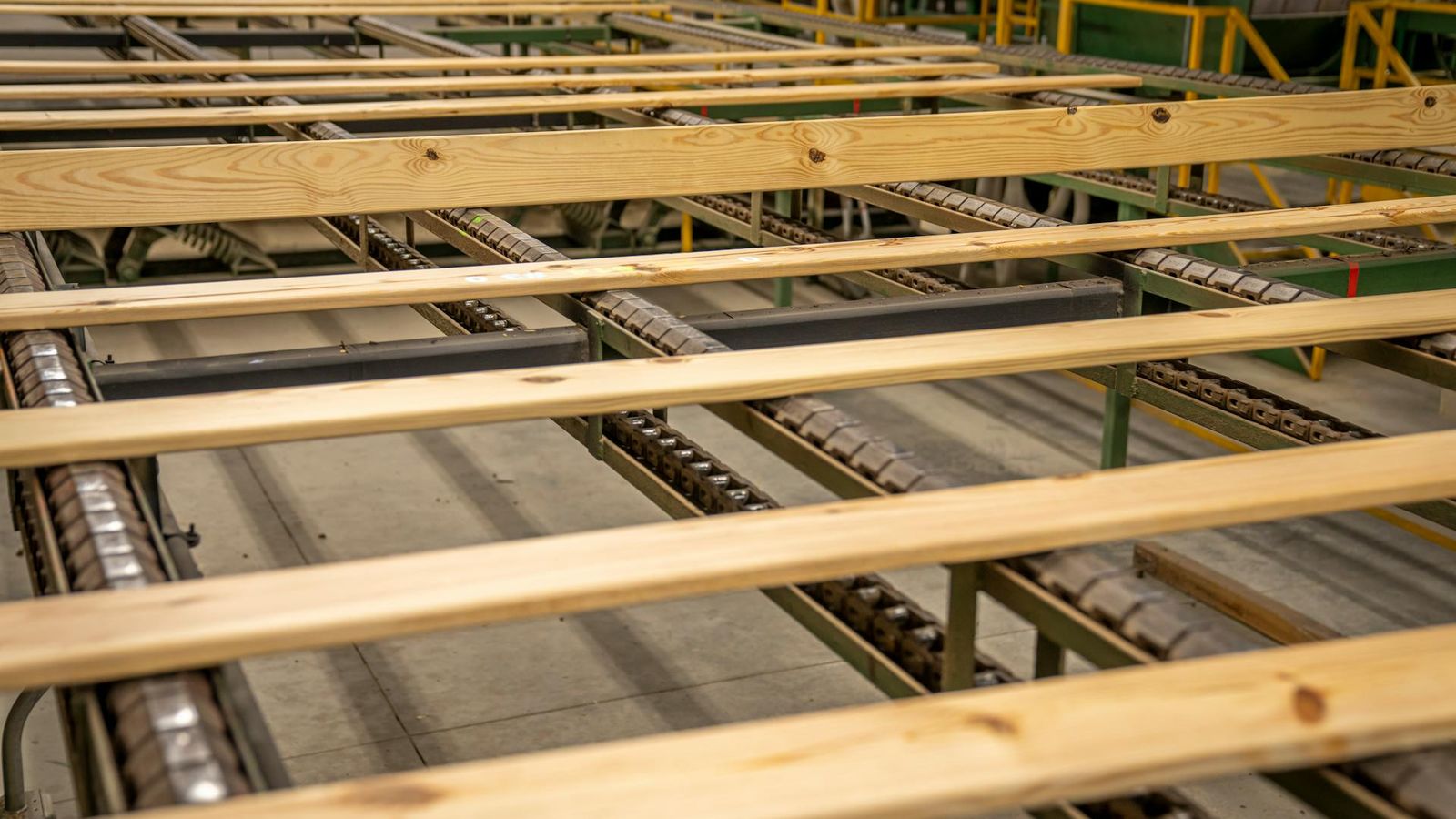
What is automated quality inspection for wood-panel production?
AI defect detection for wood panels uses a camera and a vision model to watch every panel as it leaves the hot press, the sander, and the edge-trim station, and to flag non-conforming sheets before they reach the stacker. Instead of a press operator at the panel or rigid rule-based vision, the model learns the veneer species, glue-line thickness, surface finish, and edge geometry of your SKU portfolio, and applies a consistent visual checkpoint across shifts, line speeds, and construction changeovers.
Wood panels are particularly hard to inspect at line speed because the natural grain and knot pattern of the face veneer varies inside the same pallet by design, the glue-line shows up differently on every species, and the surface stain that ruins a kitchen cabinet looks identical to a normal grain feature under warehouse lighting. Rule-based vision built around a single panel construction breaks the moment you swap to a different veneer, a different glue chemistry, or a different finish. AI-led inspection handles those variations because the model learns from real production frames rather than from a fixed threshold.
The result is an automated visual checkpoint that complements your end-of-line sample and gives you a sheet-by-sheet image record. When a furniture-OEM query comes back six weeks later, you can pull the frames from the exact production window and either confirm the defect or push back with evidence.
Defects we catch on wood-panel production lines
Surface delamination
Surface delamination is the partial separation of the face veneer or the decorative film from the core, caused by moisture in the substrate, undercured adhesive, or heat-platen drift during pressing. It often shows up first as a faint blister near the edge or as a localised dull patch where the bond has lifted, well before the panel splits open in the cabinet shop. Operators at the trim saw catch the obvious bubbles but miss the early-stage lifts that look like normal grain variation under warehouse lighting. The AI model learns the surface signature of a properly bonded panel and detects the local reflectance change long before the lift becomes obvious. Sheets are flagged, the operator checks the press cycle, and the rejected panels get diverted before they stack.
Edge chipping and tear-out
Edge chipping shows up as ragged, splintered margins along the long edge or the cross-cut, caused by dull saw blades, cross-grain feed direction, or brittle veneers that fracture under the trim cut. Severe chip-out makes the sheet unusable in any visible application. Manual operators catch the worst cases but miss the borderline edges that pass the trim station and fail at the customer's CNC. The AI model picks up the edge texture in a single frame and flags any sheet that exceeds your acceptance threshold, with the frames available so you can adjust blade-change cadence or feed speed before the next stack ships.
Glue-line voids and squeeze-out
Glue-line voids are gaps in the adhesive layer between core and face veneers, caused by uneven adhesive spread, low spread weight, or trapped air during pressing. Squeeze-out is the inverse, where excess adhesive bleeds through the face and leaves a dark stain or a sticky surface that downstream finishing cannot recover. Both defects are nearly invisible in the press but ruin the panel at the cabinet shop. The AI model holds the visual signature of a properly bonded edge for each construction and flags both starvation and bleed-through as soon as the local pattern deviates from spec.
Surface staining and discolouration
Surface stains include water marks, sap bleed, glue squeeze-out, oil drips, and roller residue that mark the face veneer after pressing. Causes range from feedstock moisture to roller wear in the sander, and the worst offenders survive the QC sample because they sit between the four corners the operator inspects. The AI model holds a learned reference shade for each species and finish and flags drift as soon as the local colour delta exceeds your spec, giving the line a chance to correct upstream conditions before a pallet of out-of-shade sheets reaches the warehouse.
Knot showthrough and patches
Knot showthrough is the bleed of a knot or a defect from the core layer up through the face veneer, caused by thin face plies, shrinkage, or pressure-driven core movement during the press cycle. Patches are the corrective inserts the production line uses to repair voids, and a poorly placed patch shows up against the surrounding grain at the customer's finishing station. Manual operators catch the obvious cases but miss the ones that pass under warehouse lighting and fail under the cabinet-shop's polished veneer finish. The AI model learns the in-spec face texture and flags showthrough and patch deviations at the press exit.
Thickness and density variation
Thickness variation is the dimensional drift across the panel face caused by uneven mat formation, platen wear, or pressing-cycle deviation, and it shows up as out-of-flat sheets, edge-to-centre wedge, or local thin spots that ruin a downstream lamination. Density variation is the cousin defect that produces soft spots and screw-pull failures in the cabinet shop. Calliper sampling at break catches the trend but misses the windows in between. The AI model picks up the surface deflection signature at the cooling tunnel and flags the sheets that fall outside your acceptance band before they reach the stacker.
The lighting setup that makes this work on a panel line is a diffuse overhead light over the press exit to read surface texture and stains, plus a low-angle ring light at the trim-saw station to read edge chip-out. An iPhone Pro with macro and wide-angle lenses handles the seven defect families from a single inspection station per critical control point. We synchronise the rig with the conveyor encoder so that flagged sheets drive a downstream divert or hold decision. We spec the optics with you during onboarding.
How Enao runs on a wood-panel line
The full hardware rig costs less than €1,000 and consists of a refurbished iPhone Pro, a diffuse overhead light with an optional low-angle ring light for edge inspection, a USB-C cable, and a mount that clamps over the press exit, the sander outfeed, or the trim-saw station. PLC integration is not required for the first deployment, the rig fits in a flight case, and the line keeps running while you set it up.
Onboarding is self-serve. Your line team mounts the rig, opens the Enao app, and starts collecting reference frames at the next changeover. Day one returns 80% accuracy without any prior labelling, and by day fourteen the model is operating above the manual inspector on the defect families it has seen, improving with every flagged sheet that the line confirms or rejects.
Each line teaches its own model what its veneer species, glue lines, and surface finishes look like. When you swap to a different construction on the same press, the model adapts in a single shift. When you bring a sister line online with a similar product family, the second model starts from the first model's experience and the marginal effort drops sharply.
Out-of-spec sheets stop reaching the stacker, scrap is logged at the inspection point rather than at the QC office, and your operators get back the hours of attention they need for the parts of the job that still need a human, including press setup, glue-line tuning, and customer complaints.
How Enao compares to manual inspection and traditional machine vision
For wood-panel producers the comparison sharpens around five dimensions.
-
Setup time on a wood-panel line. — Manual visual inspection: hours of training per operator, ongoing labour. Traditional machine vision (intelgic, Robovision, Cognex): three to nine months of integration with a system integrator, plus a rule set per construction. Enao: deployed in a week by your own team, day one at 80% accuracy.
-
Hardware cost per line. — Manual visual inspection: none upfront, ongoing labour cost. Traditional machine vision: €40,000 to €200,000 per line for industrial cameras, structured lighting, and integration. Enao: under €1,000 per line with a refurbished iPhone Pro, lamp, and mount.
-
Handling new species, finishes, and constructions. — Manual visual inspection: re-train operators for every new SKU. Traditional machine vision: rewrite the rule set per recipe, often outsourced to the integrator. Enao: re-teach the model on new species and finishes in a single shift, no code to touch.
-
Detection accuracy on subtle stains and glue-line drift. — Manual visual inspection: high at shift start, drops measurably after three hours. Traditional machine vision: strong on dimensional checks, weak on subtle stain drift and glue-line bleed-through. Enao: learns surface and edge signatures from reference frames and holds accuracy across shifts and runs.
-
Who runs it. — Manual visual inspection: trained operator at the trim saw. Traditional machine vision: system integrator or a specialised vision engineer. Enao: your line team, no external specialist required.
Furniture and construction OEMs change vendors over the cost of a delaminated batch, and the cost of a chargeback or a quiet category-manager phone call sits well above the cost of an iPhone-based inspection rig. Enao is built for that gap.