Savoury Snacks
Catch burn marks, broken pieces, seasoning gaps, and shape defects before bags leave the bagger.
Automated quality inspection for savoury snack production, running on a refurbished iPhone alongside your fryer, conveyor and bagger.
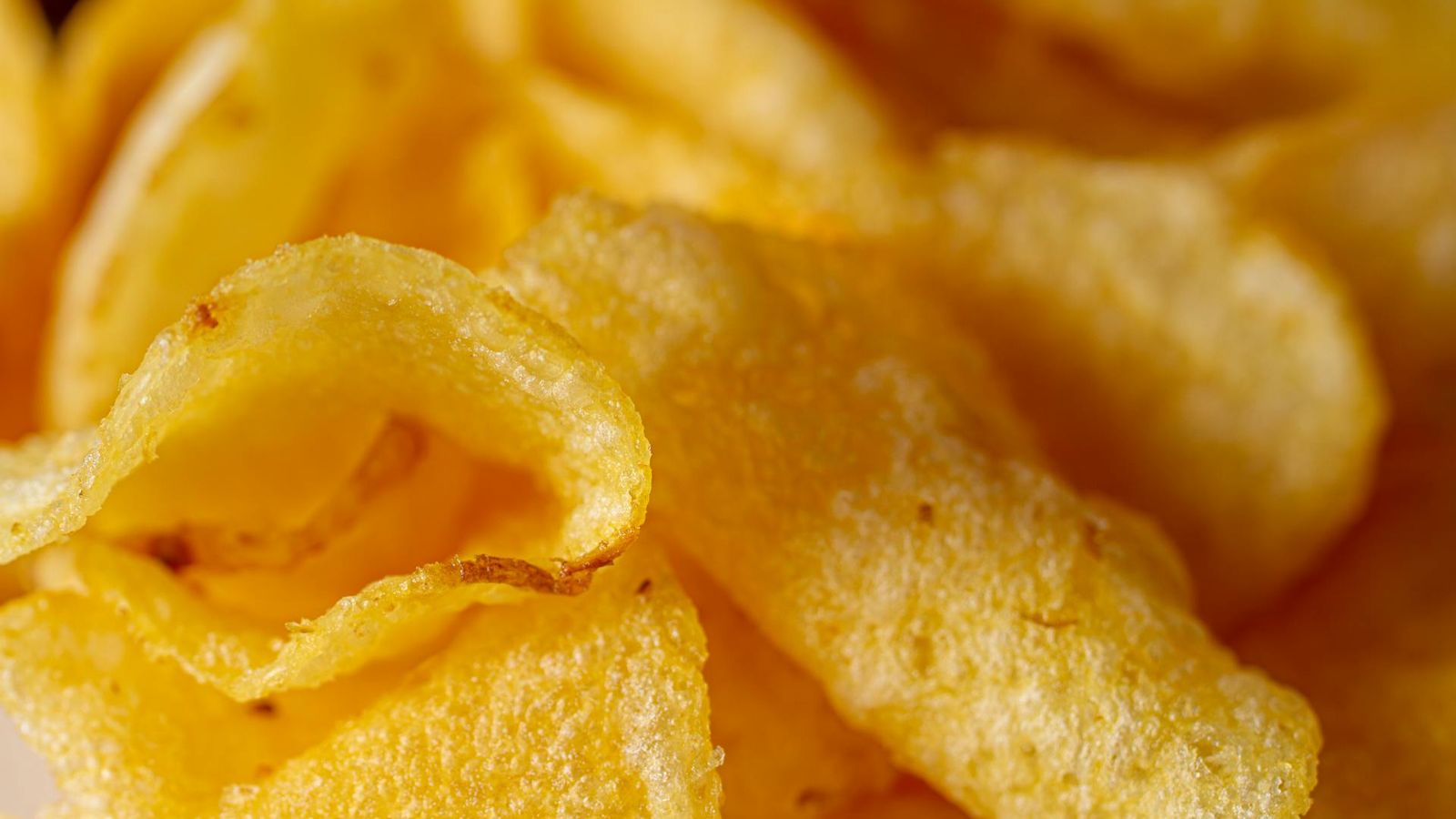
What is automated quality inspection for savoury snack production?
AI defect detection for savoury snacks uses a camera and an AI model to watch every kilogram as it leaves the fryer, the cooling tunnel and the seasoning drum, and to flag non-conforming product before it reaches the bagger. Instead of relying on a fryer operator at the panel or on rigid rule-based vision, the AI learns the specific cut shape, surface texture, fry colour and seasoning coverage of your SKU portfolio, and applies a consistent visual checkpoint across shifts, line speeds and recipe changeovers.
Savoury snacks are particularly hard to inspect at line speed because the fry colour sits on a narrow band between underdone and burnt, the geometry of a kettle-cut chip varies inside the same bag by design, and the seasoning is meant to look uneven up close while still hitting an average coverage per piece. Rule-based vision built around a single recipe breaks the moment you swap to a different cut, a different oil age, or a different seasoning blend. AI-led inspection handles those variations because the model learns from real production frames rather than from a fixed threshold.
The result is an automated visual checkpoint that complements your end-of-run QC sample and gives you a kilogram-by-kilogram image record. When a retailer query comes back six weeks later, you can pull the frames from the exact production window and either confirm the defect or push back with evidence.
Defects we catch on savoury snack production lines
Burn marks and scorching
Burn marks are dark, often charred patches on the surface of a chip or extruded snack, caused by oil temperature spikes, hot spots in the fryer, or pieces that stall against a paddle and overcook. They are most common after a flow disturbance, a salt or starch buildup on the heating element, or a slow drift in oil quality across the day. Operators at the cooling tunnel catch obvious black pieces but miss the darker-than-spec brown chip that still passes a quick glance under warehouse lighting. The AI model learns the acceptable fry-colour band for each SKU from the first half hour of a run and detects the local contrast change long before the cluster becomes obvious. Pieces are flagged, the operator checks the fryer profile, and the rejected kilograms get diverted before they bag.
Colour drift
Colour drift is a gradual shade change across a run, caused by oil age, cumulative starch load, seasoning carry-over from a previous SKU, or hopper loading inconsistency on extruded products. The first kilogram and the last kilogram of the run can sit at different LAB values without any operator noticing, and the retailer mixes bags from both windows into the same shelf set. The AI model holds a learned reference shade for each SKU and flags drift as soon as the local colour delta exceeds your spec, giving the line a chance to correct fryer settings or initiate an oil top-up before a kilogram of out-of-shade product reaches the bagger.
Broken and undersized pieces
Broken pieces are chips and extruded snacks that fail the size minimum, caused by fryer agitation, drop heights between conveyors, mechanical handling at the seasoning drum, or brittle batches from a compositional drift. Excess fines pull bag weight average down, push the visible product profile below shelf expectation, and concentrate seasoning on the wrong surface area. Manual sampling at break catches the trend but misses the windows in between. The AI model picks up the size distribution at the cooling tunnel and flags the band as soon as the proportion of fines or broken pieces crosses your acceptance threshold.
Foreign material contamination
Foreign material is anything in the snack stream that is not the snack: plastic from a torn glove, a wood splinter from a pallet, a piece of metal too small for the detector, or a fragment of paper from a seasoning bag. Metal detectors and X-ray catch the obvious cases, but they miss low-contrast plastic and organic foreign material. A surface camera picks up the colour and texture difference against the snack background, and the AI model learns the visual signature of the materials your historical complaint record actually flags. Pieces are diverted at the cooling tunnel before they bag, and the operator gets an early signal that the upstream process needs attention.
Shape malformation
Shape malformation covers the unfried slabs that come through a kettle-cut line stacked together, the extruded snacks that stretch or curl outside the design tolerance, and the chips that fold against themselves in the fryer. Operators look for the obvious cases at the panel but cannot watch every piece at line speed. The AI model learns the in-spec geometry envelope for each SKU and flags pieces that fall outside, so the line can divert before the bag fills with chips that consumers will see as off-brand at the shelf.
Seasoning distribution defects
Seasoning distribution defects are bags where the average seasoning coverage per piece is below your spec, where one face of the chip is bare, or where the seasoning has clumped on a small fraction of pieces while the rest sit naked. Causes include drum dosing variability, humidity-driven sticking on the snack surface, and uneven oil residue from the fryer. Manual sampling cannot resolve coverage at the per-piece level. The AI model learns the visual signature of an in-spec seasoned chip from reference frames and flags the local coverage shortfall as soon as it crosses your tolerance, with the frames available so the operator can push back when the seasoning supplier blames the line.
The lighting setup that makes this work on a snacks line is a diffuse overhead light over the cooling tunnel to read fry colour and surface texture, plus a low-angle ring light at the seasoning exit to read coverage and particle distribution. An iPhone Pro with macro and wide-angle lenses handles the seven defect families from a single inspection station per critical control point. We synchronise the rig with the conveyor encoder so that flagged batches drive a downstream divert or hold decision. We spec the optics with you during onboarding.
How Enao runs on a savoury snacks line
The full hardware rig costs less than €1,000 and consists of a refurbished iPhone Pro, a diffuse overhead light with an optional low-angle ring light for seasoning coverage, a USB-C cable, and a mount that clamps over the cooling tunnel or the seasoning exit. PLC integration is not required for the first deployment, the rig fits in a flight case, and the line keeps running while you set it up.
Onboarding is self-serve. Your line team mounts the rig, opens the Enao app, and starts collecting reference frames at the next changeover. Day one returns 80% accuracy without any prior labelling, and by day fourteen the model is operating above the manual inspector on the defect families it has seen, improving with every flagged batch that the line confirms or rejects.
Each line teaches its own model what its cut shapes, fry-colour palettes, and seasoning blends look like. When you swap to a different SKU on the same line, the model adapts in a single shift. When you bring a sister line online with a similar product family, the second model starts from the first model's experience and the marginal effort drops sharply.
Out-of-spec batches stop reaching the bagger, scrap is logged at the inspection point rather than at the QC office, and your operators get back the hours of attention they need for the parts of the job that still need a human, including fryer setup, seasoning calibration, and customer complaints.
How Enao compares to manual inspection and traditional machine vision
For savoury snack producers the comparison sharpens around five dimensions.
-
Setup time on a savoury snacks line. — Manual checks at the bagger miss colour drift on long shifts. Traditional machine vision (KPM Analytics, Robovision, Mekitec, aqrose, engilico) requires three to nine months of integration and a six-figure budget. Enao is deployed in a week by your own team on a refurbished iPhone, day one at 80% accuracy.
-
Hardware cost per line. — Manual visual inspection: none upfront, ongoing labour cost. Traditional machine vision: €40,000 to €200,000 per line for industrial cameras, structured lighting, and integration. Enao: under €1,000 per line with a refurbished iPhone Pro, lamp, and mount.
-
Handling new cuts, recipes and seasonings. — Manual visual inspection: re-train operators for every new SKU. Traditional machine vision: rewrite the rule set per recipe, often outsourced to the integrator. Enao: re-teach the model on new cuts and seasonings in a single shift, no code to touch.
-
Detection accuracy on subtle colour and seasoning drift. — Manual visual inspection: high at shift start, drops measurably after three hours. Traditional machine vision: strong on size sorting, weak on subtle colour drift and seasoning coverage. Enao: learns fry colour and seasoning signatures from reference frames and holds accuracy across shifts and runs.
-
Who runs it. — Manual visual inspection: trained operator at the cooling tunnel. Traditional machine vision: system integrator or a specialised vision engineer. Enao: your line team, no external specialist required.
SKU rosters change with every retailer promotion and every limited-edition flavour, and the cost of a withdrawal or a quiet category-manager phone call sits well above the cost of an iPhone-based inspection rig. Enao is built for that gap.
Savoury snack inspection FAQ
Related industries
Cookies and Biscuits
Catch under-baked centres, broken pieces, decoration defects and bake-colour drift before trays leave the cooling tunnel.
Bread and bakery
Catch bake-colour drift, surface cracks, dough-piece weight errors, seed-topping coverage, and seal defects before loaves leave the bagger.
Food packaging
Catch seal defects, label misprints, fill-level errors, and contamination before packs leave the line.