Plastic Extrusion
Catch die lines, plate-out, sink marks, and dimensional drift before pipes, profiles, sheet, and cable leave the calibrator.
Automated quality inspection for plastic extrusion across window profiles, pipes and tubes, sheet and film, cable jackets, and decking, running on a refurbished iPhone alongside your existing pull-off and saw stations.
What is automated quality inspection for plastic extrusion?
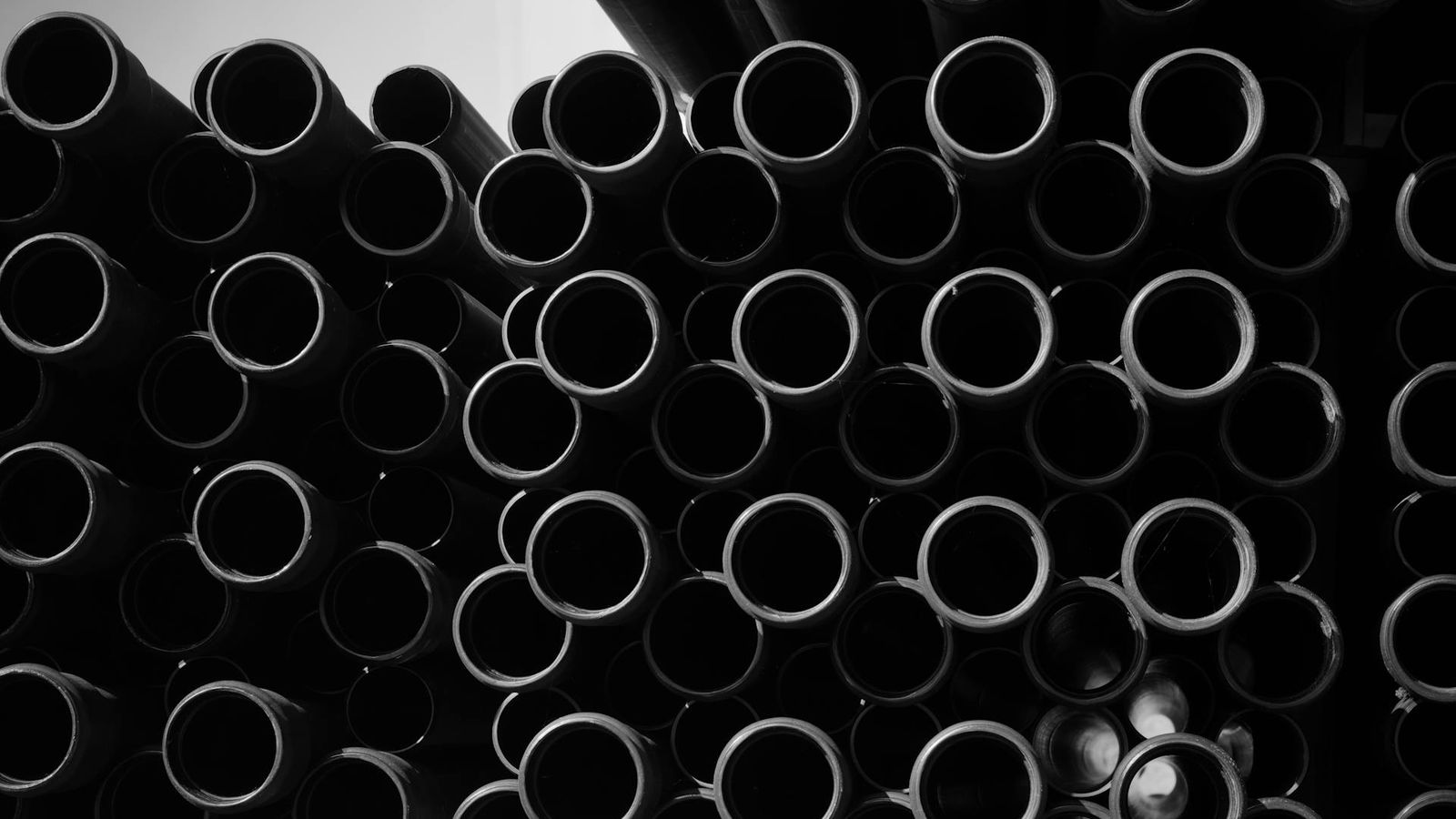
AI defect detection for plastic extrusion uses a camera and an AI model to watch every metre as it leaves the calibrator and the haul-off, and to flag non-conforming sections before they reach the cut-off saw or the winder. Instead of relying on a human inspector at the saw or on rigid rule-based vision, the AI learns the specific die geometry, surface texture, masterbatch shade, and dimensional envelope of your product families, and applies a consistent visual checkpoint across shifts, line speeds, resin changes, and colour changeovers.
Plastic extrusion lines are particularly hard to inspect at line speed because the visible face is often a high-gloss or matte surface that reflects fluorescent light unevenly, the geometry can be a hollow chamber on a window profile, a thin wall on a pipe, a compounded jacket over a copper conductor, or a continuous sheet on a take-off, and the cooling profile leaves the surface temperature varying over the first metre of haul-off. Rule-based vision built around a single die geometry breaks the moment you swap to a different profile, a different pipe diameter, or a different compound. AI-led inspection handles those variations because the model learns from real production frames rather than from a fixed threshold.
The result is an automated visual checkpoint that complements your end-of-run sample test and gives you a metre-by-metre image record. When a customer claim comes back six weeks later, you can pull the frames from the exact section and either confirm the defect or push back with evidence.
Defects we catch on plastic extrusion lines
Die lines
Die lines are continuous longitudinal streaks on the extrudate surface, caused by buildup, scratches, or burnt material on the die land. They open up gradually as a die wears through a run, and they sit exactly on the visible face of a window profile, the outer wall of a pipe, the show side of a decking board, or the jacket of a cable. Inspectors at the cut-off saw often miss the early stage because the line is faint under direct fluorescent light. The AI model learns the clean surface signature from the first half hour of a run and detects the longitudinal contrast change long before the streak becomes obvious. The line is flagged, the operator purges and polishes the die, and the rejected metres get cut out before they ship.
Plate-out smear
Plate-out is a deposit of additives, lubricants, or stabiliser residue that migrates from the melt onto the die surface and then transfers back onto the extrudate as a hazy, often slightly off-colour smear. It develops over the course of a long run and is most visible on dark or coloured product where the smear shows as a shade shift, on pipe, profile, or cable jacket alike. Manual inspection misses plate-out because the shift is gradual and the inspector's colour calibration drifts with fatigue. The AI model compares the local surface chroma against the learned reference for the SKU and flags the colour delta as soon as it crosses the tolerance you set during onboarding.
Sink marks
Sink marks are local surface depressions over the thicker sections of an extrudate, caused by uneven cooling after the calibrator. They are most common on profiles with internal ribs and on pipe with a thicker wall transition, where the material behind the visible face stays hot longer and pulls the surface inward as it shrinks. Manual inspectors notice severe sinks but miss the borderline cases that still fail when the fabricator paints, laminates, or pressure-tests downstream. The AI model picks up the local geometry deviation at low-angle ring lighting and reports the sink depth against your acceptance threshold.
Bubbles and voids
Bubbles and voids are gas pockets trapped in the melt, caused by undried compound, moisture in the masterbatch, or excessive shear in the screw. They show up as small surface blisters or, more commonly, as internal voids inside hollow chambers, pipe walls, and cable jackets that you only catch when the part is cut or pressure-tested. A surface inspector cannot see internal voids, but the AI model picks up surface bubbling and the subtle wall-thickness shift that signals a void underneath, by tracking the relationship between the visible surface and the transmitted-light view from the chamber side or the bore.
Colour drift
Colour drift is a gradual shade change across a run, caused by masterbatch dispersion variability, hopper loading inconsistency, or screw temperature drift. The first metre and the last metre of the run can sit at different LAB values without any inspector noticing, and the customer mixes product from both runs into the same job: a window order, a pipe lot, a cable drum, a sheet stack. The AI model holds a learned reference shade for each SKU and flags drift as soon as the local colour delta exceeds your spec, giving the operator a chance to correct the dosing before a metre of out-of-shade product reaches the saw or the winder.
Dimensional drift
Dimensional drift is a slow change in width, height, wall thickness, or outside diameter across a run, caused by die heater drift, calibrator vacuum loss, or haul-off speed instability. End-of-run sample measurements catch the extreme cases but miss the slow creep that puts a chamber wall, a pipe wall, or a cable jacket just under the structural minimum. The AI model tracks the cross-section dimensions against your nominal envelope and flags the section as soon as the local width, OD, or wall thickness drifts outside tolerance, well before the post-run gauge reading tells you the same thing twenty minutes later.
The lighting setup that makes this work on a plastic extrusion line is a low-angle ring light to surface die lines and scratches, a diffuse strip light over the haul-off to read colour, and a backlight or transmitted-light box where wall thickness needs to be checked on profile chambers, pipe walls, or cable jackets. An iPhone Pro with macro and wide-angle lenses handles the seven defect families from a single inspection station. We synchronise the rig with the haul-off encoder and cut-off saw signal so that flagged sections drive a downstream marking or rejection decision. We spec the optics with you during onboarding.
How Enao runs on a plastic extrusion line
The full hardware rig costs less than €1,000 and consists of a refurbished iPhone Pro, a low-angle ring light with an optional diffuse strip light for colour, a USB-C cable, and a mount that clamps over the haul-off. PLC integration is not required for the first deployment, the rig fits in a flight case, and the line keeps running while you set it up.
Onboarding is self-serve. Your line team mounts the rig, opens the Enao app, and starts collecting reference frames at the next die change. Day one returns 80% accuracy without any prior labelling, and by day fourteen the model is operating above the manual inspector on the defect families it has seen, improving with every flagged metre that the line confirms or rejects.
Each line teaches its own model what its die geometries, colour palettes, and wall-thickness envelopes look like. When you swap to a different SKU on the same line, the model adapts in a single shift. When you bring a sister line online with a similar product family, the second model starts from the first model's experience and the marginal effort drops sharply. A profile line moving from white window stock to brown decking, or a pipe line moving from a 32 mm to a 50 mm OD, absorbs the change in one shift.
Out-of-spec metres stop leaving the saw or the winder, scrap is logged at the inspection point rather than at the QC office, and your operators get back the hours of attention they need for the parts of the job that still need a human, including die changes, masterbatch troubleshooting, and customer claims.
How Enao compares to manual inspection and traditional machine vision
For plastic extruders running profile, pipe, sheet, cable, or decking, the comparison sharpens around five dimensions.
-
Setup time on a plastic extrusion line. — Manual checks at the saw miss subtle surface streaks. Traditional machine vision (Maddox.ai, Cognex, intelgic, groundlight, dac.digital) requires three to nine months of integration and a six-figure budget. Enao is deployed in a week by your own team on a refurbished iPhone, day one at 80% accuracy.
-
Hardware cost per line. — Manual visual inspection: none upfront, ongoing labour cost. Traditional machine vision: €40,000 to €200,000 per line for industrial cameras, structured lighting, and integration. Enao: under €1,000 per line with a refurbished iPhone Pro, lamp, and mount.
-
Handling new resins, geometries, and colours. — Manual visual inspection: re-train inspectors for every new geometry, compound, and shade. Traditional machine vision: rewrite the rule set per SKU, often outsourced to the integrator. Enao: re-teach the model on new geometries and colours in a single shift, no code to touch. PVC, PE, PP, ABS, PC, and the filled and foamed grades all behave the same way for the camera.
-
Detection accuracy on subtle surface and shade defects. — Manual visual inspection: high at shift start, drops measurably after three hours. Traditional machine vision: strong on edge geometry, weak on subtle die lines and gradual colour drift. Enao: learns die-line and colour signatures from reference frames and holds accuracy across shifts and runs.
-
Who runs it. — Manual visual inspection: trained inspector at the saw or the winder. Traditional machine vision: system integrator or a specialised vision engineer. Enao: your line team, no external specialist required.
Product portfolios change with every customer programme, and the cost of a recall or a customer credit note sits well above the cost of an iPhone-based inspection rig. Enao is built for that gap.
Plastic extrusion inspection FAQ
Related industries
Plastic Injection Moulding
Catch sink marks, flash, short shots, and weld lines before parts leave the press.
Food packaging
Catch seal defects, label misprints, fill-level errors, and contamination before packs leave the line.
Pharmaceutical packaging
Catch missing tablets, blister-foil defects, label errors, and serialisation faults before packs leave the line.