Hand tools
Catch forging cracks, plating defects, handle-overmould errors, marking legibility, and packaging issues before tools leave the assembly cell.
Automated quality inspection for hand-tool production, running on a refurbished iPhone alongside your forging press, trim station, plating line, handle-overmould cell, and blister-pack station.
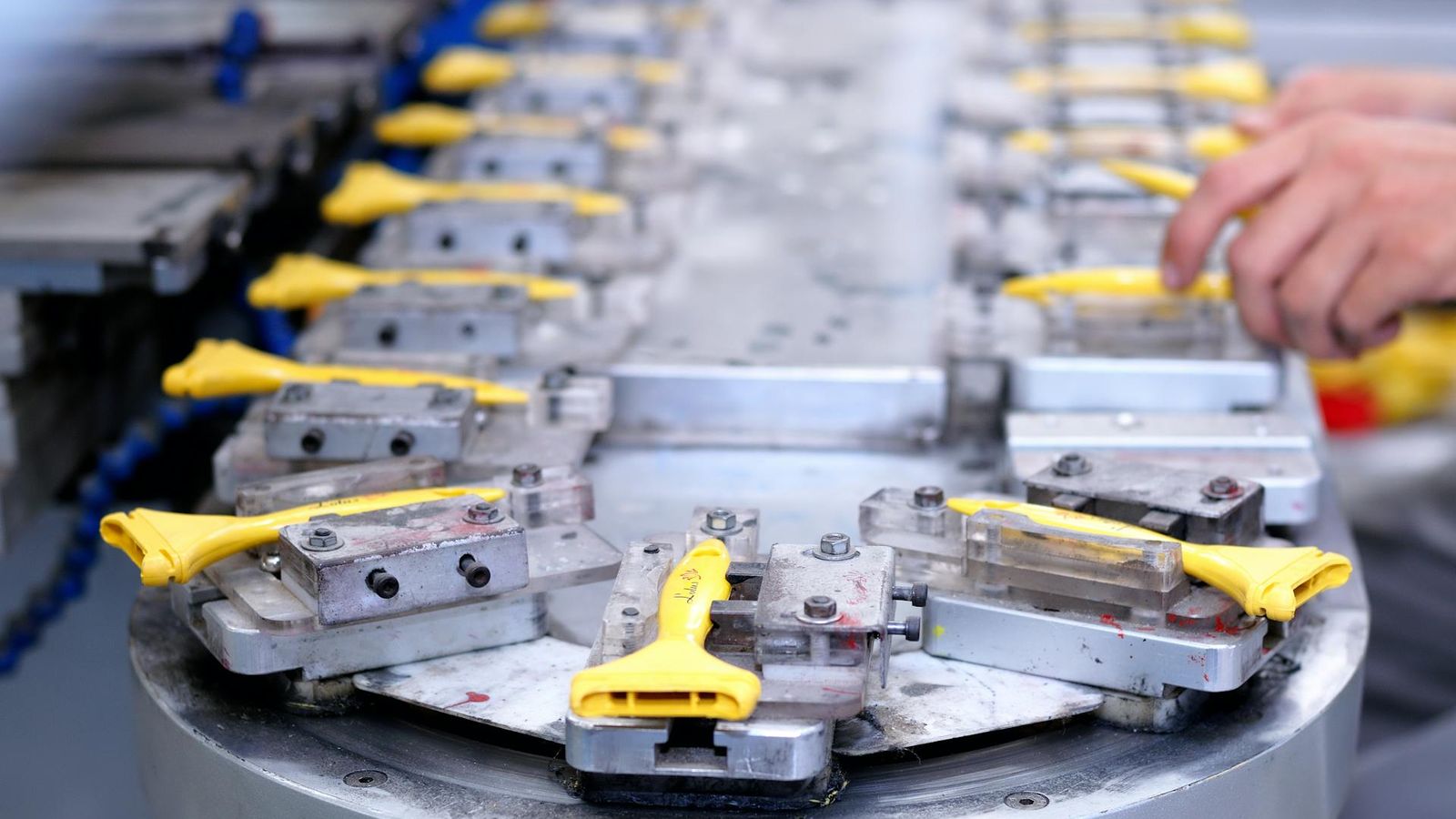
What is automated quality inspection for hand-tool production?
AI defect detection for hand tools uses a camera and a vision model to watch every tool as it leaves the forging press, the trim station, the plating line, the handle-overmould cell, and the blister-pack station, and to flag non-conforming units before they reach dispatch. Instead of an operator at the inspection bench or rigid rule-based vision, the model learns the forging signature, plating finish, handle-overmould geometry, and marking pattern of your SKU portfolio, and applies a consistent visual checkpoint across shifts, line speeds, and grade changeovers.
Hand tools are particularly hard to inspect at line speed because the surface finish reads differently across chrome, satin, and black-oxide platings, the handle overmould varies inside the same SKU run by design, and the cracked forging that fails the customer's drop test looks identical to a normal radius edge under workshop lighting. Rule-based vision built around a single SKU breaks the moment you swap to a different head, a different handle, or a different finish. AI-led inspection handles those variations because the model learns from real production frames rather than from a fixed threshold.
The result is an automated visual checkpoint that complements your bench sample and gives you a tool-by-tool image record. When a retailer or warranty query comes back six weeks later, you can pull the frames from the exact production blister and either confirm the defect or push back with evidence.
Defects we catch on hand-tool production lines
Forging cracks and head defects
Forging defects include radial and axial cracks at the forging-flash line, cold-shut marks, and head deformation caused by die wear, billet-temperature drift, or press overload. Cracks fail the drop and torque tests at the merchant's goods-in inspection, and head deformation triggers field-failure complaints from professional trades. Operators check forgings by eye at the trim bench but cannot watch every part. The AI model learns the in-spec forging signature for each SKU and flags cracks, cold-shut, and head deformation at the trim-station exit so the line can change the dies before a full run ships.
Plating coverage and thin spots
Plating defects include thin spots, run marks, bare patches, and dull chrome caused by rectifier drift, rack-load imbalance, or rinse-tank contamination. Thin spots fail the salt-spray test on professional-grade SKUs, and dull chrome triggers DIY-retailer cosmetic rejection at the depot. Operators check plating colour by eye but miss the slow drift over a long bath cycle. The AI model learns the in-spec plating colour and reflectance for each finish and flags thin spots, run marks, and bare patches at the plating-line exit so the line can adjust before a full rack ships.
Handle-overmould flash and bond defects
Handle defects include overmould flash, short-shot grip patches, weld-line marks, and bond-failure peeling caused by overmould-tool wear, plastic-batch chemistry change, or bonding-temperature drift. Bond failure causes the grip to peel off in the customer's hand, and overmould flash fails the cosmetic inspection at the merchant's depot. The AI model learns the in-spec handle signature for each SKU and flags flash, short-shot, weld-line, and peeling at the handle-cell exit so the line can adjust before a full cycle ships.
Jaw, head, and cutting-edge geometry
Geometry defects include off-centre jaws, twisted heads, dull cutting edges, and out-of-spec opening angles caused by trim-die wear, head-fixture drift, or grinding-wheel wear. Off-centre jaws fail the meshing test at the customer's bench, and dull edges trigger trade-customer warranty claims. The AI model learns the in-spec geometry signature for each SKU and flags drift at the trim or grinding station so the line can adjust before a full run ships.
Marking legibility and size-stamp errors
Marking defects include faded laser marks, smudged ink stamps, missing size codes, and wrong-format spec marks caused by laser-power drift, inkjet ribbon issues, or recipe-changeover errors. The defects fail goods-in inspection at trade distribution and trigger consumer returns from DIY retail. The AI model reads the marking area in every frame and flags illegible, missing, or wrong-format codes at the marking cell so the line can correct before a full pallet ships.
Surface scratches and tool drag
Surface defects include drag marks on the shank, scratches from the conveyor, and tumbling-belt damage caused by handling errors, transfer-belt wear, or rack-load contamination. The defects fail the cosmetic inspection at DIY retail and trigger rework demands at the merchant's depot. The AI model holds the surface signature for each finish and flags any tool showing drag, scratch, or tumble damage at the blister-pack station before the case packer wraps it.
The lighting setup that makes this work on a hand-tool line is a diffuse overhead light over the trim and inspection bench to read forging and geometry, plus a low-angle ring light at the plating-line exit and laser-marking cell to read plating coverage and marking. An iPhone Pro with macro and wide-angle lenses handles the seven defect families from a single inspection station per critical control point. We synchronise the rig with the conveyor encoder so that flagged tools drive a downstream divert or hold decision. We spec the optics with you during onboarding.
How Enao runs on a hand-tool line
The full hardware rig costs less than €1,000 and consists of a refurbished iPhone Pro, a diffuse overhead light with an optional low-angle ring light for plating and marking inspection, a USB-C cable, and a mount that clamps over the forging press, the trim station, the plating-line exit, the handle-overmould cell, the marking cell, or the blister-pack station. PLC integration is not required for the first deployment, the rig fits in a flight case, and the line keeps running while you set it up.
Onboarding is self-serve. Your line team mounts the rig, opens the Enao app, and starts collecting reference frames at the next SKU changeover. Day one returns 80% accuracy without any prior labelling, and by day fourteen the model is operating above the bench inspector on the defect families it has seen, improving with every flagged tool that the line confirms or rejects.
Each line teaches its own model what its forging signatures, plating finishes, and handle geometries look like. When you swap to a different SKU or steel grade on the same line, the model adapts in a single shift. When you bring a sister line online with a similar product family, the second model starts from the first model's experience and the marginal effort drops sharply.
Out-of-spec tools stop reaching the blister-pack station, scrap is logged at the inspection point rather than at the QC office, and your operators get back the hours of attention they need for the parts of the job that still need a human, including die change, plating chemistry, and warranty handling.
How Enao compares to manual inspection and traditional machine vision
For hand-tool producers the comparison sharpens around five dimensions.
-
Setup time on a hand-tool line. — Manual visual inspection: hours of training per operator, ongoing labour. Traditional machine vision: three to nine months of integration with a system integrator, plus a rule set per SKU. Enao: deployed in a week by your own team, day one at 80% accuracy.
-
Hardware cost per line. — Manual visual inspection: none upfront, ongoing labour cost. Traditional machine vision: €40,000 to €200,000 per line for industrial cameras, structured lighting, and integration. Enao: under €1,000 per line with a refurbished iPhone Pro, lamp, and mount.
-
Handling new SKUs, steel grades, and finishes. — Manual visual inspection: re-train operators for every new SKU. Traditional machine vision: rewrite the rule set per head and finish, often outsourced to the integrator. Enao: re-teach the model on new heads, handles, and platings in a single shift, no code to touch.
-
Detection accuracy on subtle plating drift and marking defects. — Manual visual inspection: high at shift start, drops measurably after three hours. Traditional machine vision: strong on dimensional checks, weak on subtle plating drift and marking-legibility detection. Enao: learns forging, plating, and marking signatures from reference frames and holds accuracy across shifts and runs.
-
Who runs it. — Manual visual inspection: trained operator at the inspection bench. Traditional machine vision: system integrator or a specialised vision engineer. Enao: your line team, no external specialist required.
DIY retailers and trade-distribution category managers change vendors over the cost of a rejected blister batch, and the cost of a chargeback or a quiet listing swap sits well above the cost of an iPhone-based inspection rig. Enao is built for that gap.